
Writing training documents for artificial intelligence correctly is extremely important for its proper functioning. Think of document data as the AI’s knowledge base. Well-structured document helps AI follow instructions precisely, reducing errors and improving complex task execution.
We therefore list a few rules to follow:
- Include as the name of the document a short description of the topic you are going to cover in the text (e.g. ‘How to create an automation’).
- Insert as document text the entire description of the topic we want to use to train the AI (e.g. ‘How to create an automation’). “To create an automation follow these steps: …”
- Select the language of the inserted document. The AI will still answer in the language in which the question was asked.
It is advisable to click on optimize text once the description has been entered so that it is optimised for better learning by the AI should the need arise.
Key Points for an Effective AI Document #
1. Provide Comprehensive Business Information:
- Customer Interaction & Behavioral Data: Include historical chat transcripts, email exchanges, purchase history, and sentiment analysis data to help the AI understand customer patterns and needs.
- Product & Service Knowledge: Offer detailed specifications, user manuals, step-by-step guides, troubleshooting solutions, and Frequently Asked Questions (FAQs) for all your offerings.
- Company Policies: Clearly articulate policies related to returns, warranties, shipping, privacy, and billing.
- Backend System Data: Integrate with core systems like CRM and e-commerce platforms to provide real-time customer data (e.g., purchase history, account status) for personalized responses.
Example:
# TechSupport Pro Knowledge Base

## Product: ProConnect Router X1000
  **Description**: High-speed Wi-Fi 6 router for homes and small offices.
  **Features**: Dual-band (2.4GHz/5GHz), 4 Gigabit Ethernet ports, WPA3 security, easy mobile app setup.
  **Setup Guide**: Connect power adapter. Plug Ethernet cable from modem to WAN port. Connect devices to LAN ports or Wi-Fi.
## Service: Premium Support Plan
  **Details**: 24/7 phone and chat support, remote troubleshooting, priority service.
  **Eligibility**: Available for all ProConnect Router models.
## Company Policy: Return Policy
  **Standard Returns**: 30-day return window for unused products in original packaging.
  **Refunds**: Processed within 7 business days to original payment method.
2. Structure Content for AI Readability:
- Customer-Centric Organization: Structure content based on how customers typically search for information, not your internal organizational structure.
- Logical Hierarchy: Organize information from broad topics to specific details, making it easy for the AI to narrow its search.
- Clear Categories & Headings: Use distinct, non-overlapping categories and descriptive headings that accurately reflect the content beneath them. Employ proper HTML tags (e.g.,
<h1>,<h2>) for headings, as AI models recognize these for understanding hierarchy.
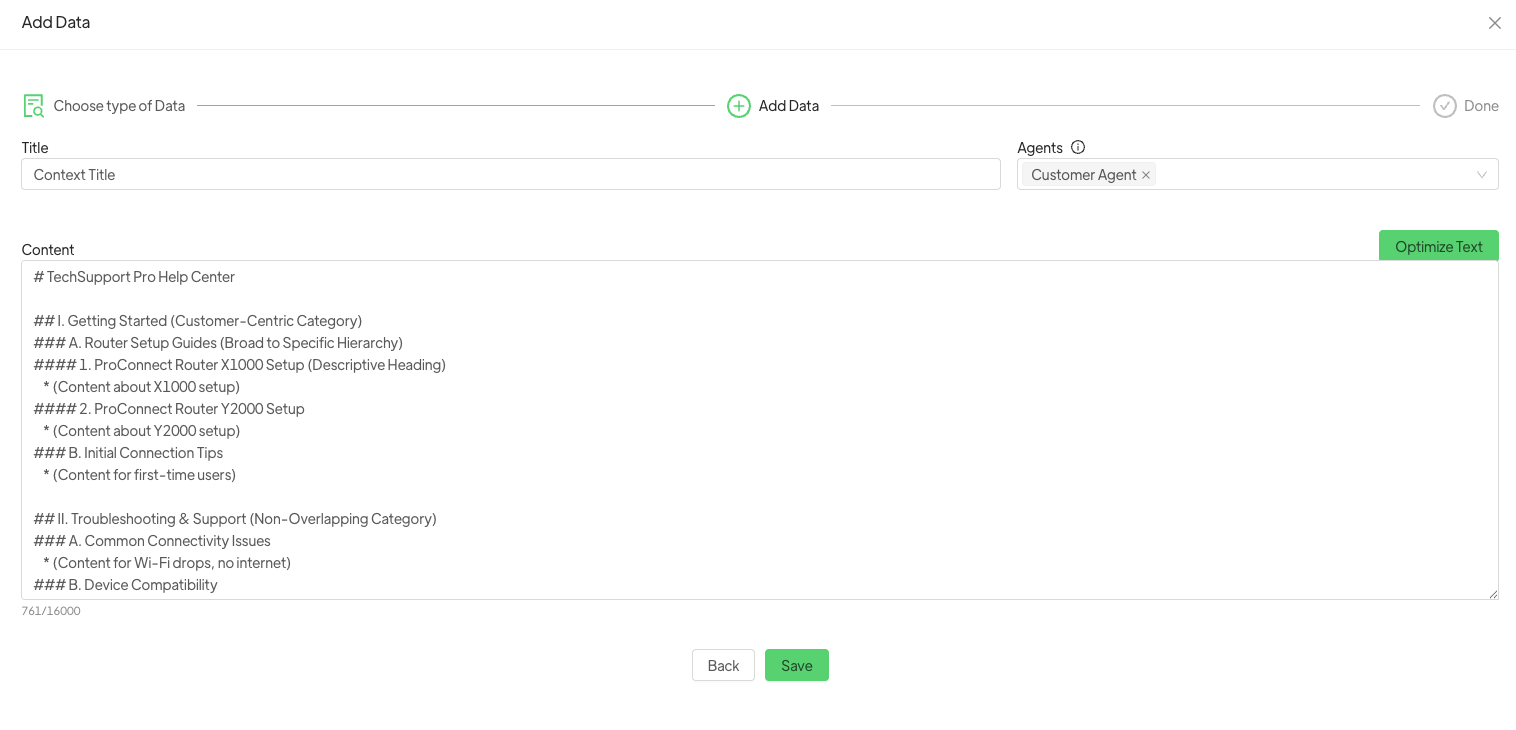
Example:
# TechSupport Pro Help Center

## I. Getting Started (Customer-Centric Category)
### A. Router Setup Guides (Broad to Specific Hierarchy)
#### 1. ProConnect Router X1000 Setup (Descriptive Heading)
    * (Content about X1000 setup)
#### 2. ProConnect Router Y2000 Setup
    * (Content about Y2000 setup)
### B. Initial Connection Tips
    * (Content for first-time users)

## II. Troubleshooting & Support (Non-Overlapping Category)
### A. Common Connectivity Issues
    * (Content for Wi-Fi drops, no internet)
### B. Device Compatibility
    * (Content for connecting various devices)

## III. Account & Billing (Distinct Category)
### A. Managing Your Account
    * (Content for profile updates)
### B. Billing Inquiries
    * (Content for payment questions)
3. Craft High-Quality, AI-Parsable Content:
- Standalone Information Chunks: Ensure all information is provided in full, complete sentences. Avoid fragments or internal references (e.g., “As you saw in our last example”), as AI presents information in discrete chunks.
- Clear & Consistent Terminology: Use unambiguous words and avoid terms with multiple meanings within your knowledge base to prevent confusion and irrelevant search results.
- Simple Language: Write concisely, using short, direct sentences. Avoid long, meandering, or overly complex sentences that are difficult for AI to parse.
- Minimize Non-Textual Core Information: Provide critical information primarily in text format. If images or videos are used, ensure accompanying text, alt text, or transcripts, as generative AI primarily processes text.
- Factual Accuracy & Consistency: All information must be consistently up-to-date, factually correct, and internally consistent across all articles.
Example:
# TechSupport Pro Content Quality

## Standalone Information Chunks
  *** Bad Example:** "Yes. Via app." (In response to "Can I set up the router using an app?")
  *** Good Example:** "Yes, you can set up your ProConnect Router X1000 quickly and easily using the dedicated TechSupport Pro mobile app."

## Clear & Consistent Terminology
  *** Bad Example:**
      * Article 1: "To access your** portal**, log in here." (Referring to customer account dashboard)
      * Article 2: "The** portal** on the router allows for cable management." (Referring to a physical opening)
  *** Good Example:**
      * Article 1: "To access your** customer dashboard**, log in here."
      * Article 2: "The** cable management opening** on the router allows for tidy cable routing."

## Simple, Direct Language
  *** Bad Example:** "It is imperative that users, upon encountering a cessation of network connectivity, initiate a diagnostic protocol by systematically verifying the operational status of all interconnected hardware components."
  *** Good Example:** "If your internet stops working, first check that all your router and modem cables are securely connected."

## Minimizing Non-Textual Core Information
  *** Recommendation:** If you have a diagram showing router ports, always include a text description of each port and its function. AI primarily processes text.
Important notes:
Always keep in mind that the documents needs to be updated or refreshed for any changes on your business processes. So please add/remove data when something (where AI context is involved) changes.