Skip to content
Supporto Spoki

Documentation for Spoki use

  • English
    • Italiano
  • English
    • Italiano

Integrations

34
  • Integrate WhatsApp with Google Sheets
  • Integrating Spoki with Facebook forms.
  • Integrating Spoki with Brevo (formerly sendinblue)
  • Integrating WhatsApp with Zapier
  • WhatsApp and WooCommerce Integration
  • Integrating WhatsApp with Hubspot
  • Integrating WhatsApp with Qapla’
  • Integrating WhatsApp with ActiveCampaign
  • Klaviyo and Spoki Integration.
  • Integrating WhatsApp with IFTTT
  • Integrate WhatsApp with Zoho
  • Integrate WhatsApp to WPNotif
  • Integrate WhatsApp with Semplisio
  • Integrating Spoki with Webhooks
  • Integrate Prestashop to WhatsApp
  • Integrate Spoki with any management system via API
  • Integrating Calendly with Spoki
  • Integrate WhatsApp with Google Calendar
  • How to send a Webhook out of Spoki vs. a management system
  • Integrating WhatsApp with Paypal
  • Zadarma
  • Embed Spoki on your Software
  • Spoki Integration with Connectif: Automating WhatsApp Messages
  • Integrate WhatsApp with Shopify
  • Insert Chat Button on Shopify
  • Get Started with Spoki MCP
  • Sync Klaviyo Lists and Segments with Spoki
  • Gorgias
  • Make
  • Shopify App
  • Ringover
  • Magnews Flow
  • Salesforce Flow

Platform

15
  • Lists
  • Dynamic fields
  • Import CSV from Lists
  • Apply for OBA (Official Business Account) WhatsApp
  • Ticket
  • How to verify the authenticity of Spoki emails
  • Contact
  • Dashboard
  • Chat
  • Campaigns
  • Template messages
  • Chat buttons
  • Tags
  • Integrations
  • Automations

How to

86
  • How to create a simple automation from the Campaigns section
  • Spoki on your Smartphone – Web App and Notifications
  • “Delay” Step: When and How to Use It
  • Quick Action “If/Else”
  • How to Filter Chats by One or More Tags/Agents/Lists/Tickets
  • Marketing Consent on Spoki: Operational Guide
  • Guide to the Branching Option in Automations
  • Introduction to Using the OTP Code
  • Guida allo step “Attendi risposta”
  • How to Upload a Contact List on Spoki: A Step-by-Step Guide
  • Crafting AI Prompts
  • How to send the content of a message to an external webhook
  • Multiple steps in automation
  • HOW TO TRACK CLICKS ON TEMPLATE MESSAGE LINKS: UTM
  • How to write documents for AI
  • Template suggested by Artificial Intelligence (AI)
  • How to create a marketing funnel on Shopify
  • Integrating Spoki with Meta Listings
  • How to build your own AI Agent
  • Restore all blocked contacts
  • Translate messages and replies if the contact has a different language
  • Transcription and translation of audio in chat
  • Permanently delete a contact on Spoki
  • How to export all messages from a chat as CSV
  • How to change media in the Template before sending it in chat
  • How to create a list for contacts in a specific automation step
  • New features of Active Campaign
  • How to populate a dynamic field
  • How to activate catalog display on WhatsApp
  • How to add Tag in automation before inserting it
  • How to generate a list from Campaign Statistics
  • How to segment clients within Automations.
  • How not to let your recharge expire
  • How to automatically manage who replies/does not reply to a message
  • How to terminate automation manually for specific contacts
  • How to terminate automation manually for specific contacts
  • HOW TO CREATE A LIST FOR CONTACTS IN A SPECIFIC AUTOMATION STEP
  • HOW TO GENERATE A LIST FROM CAMPAIGN STATISTICS
  • HOW TO ADD TAG IN AUTOMATION BEFORE INSERTING IT
  • New features of Active Campaign
  • How to change media in Template before sending it to chat
  • How to export all chat messages as CSV
  • Audio transcription and translation in chat
  • Delete contact permanently on Spoki
  • Train artificial intelligence (AI) on Spoki
  • Integrating Spoki with Meta Listings
  • How to set up a CTA with dynamic field
  • How to send the content of a message to an external webhook
  • How to automatically manage who replies/doesn’t reply to a message
  • Free messages with buttons
  • How to get a single contact out of all automations
  • Spoki – first steps
  • How to transfer contacts from your Whatsapp app to Spoki
  • How to handle cases when I have to send a chat reply to a customer after 24 hours?
  • How to withdraw from Spoki service
  • HOW TO LINK SPOKI TO FACEBOOK INTERACTION CAMPAIGNS
  • How to manage booking Calendly + Active Campaign + Spoki
  • How to consult automation reporting
  • How to send multi-language messages
  • How can I identify which user has replied in chat to a message?
  • How to populate a dynamic field via CSV upload and submit a campaign
  • How to enable automation for birthday greeting message
  • How to automatically handle those who do not respond
  • How to activate the Woocommerce plugin associated with Spoki Pro
  • How to enable automation for non-working hours
  • How to link Spoki to Facebook campaigns
  • How to activate an automatic message to run on holidays
  • How to link a Chat Button on the website to an automated response
  • How to insert WhatsApp chat button on WordPress site
  • How to update Spoki’s WhatsApp profile
  • Recommended proportions for images in Whatsapp messages
  • How to create template button response automation
  • How to start an automation with API
  • How to enable notifications on Spoki
  • How to lock/unlock contacts automatically
  • How to create new users and assign different roles
  • How to integrate Spoki for your customers into your software
  • How to recover abandoned shopping carts on Woocommerce
  • How to Automatically Send a Reminder Message Using Spoki
  • How to duplicate automations/ templates
  • Managing Free Messages in the Automation Flow
  • How to attribute or remove tags to contacts in a list
  • How to delete multiple contacts
  • Migration from old Twilio provider
  • View only unread chats
  • How to Use the Return Webhook from Spoki to Zapier

Strategies

13
  • Tips for mass mailings over 10,000 contacts
  • WhatsApp Strategies for Christmas: The Complete Guide to Maximizing Sales and Customer Satisfaction
  • WhatsApp That Sells – Mini Strategic Guide by Sector
  • WhatsApp for E-commerce: How to Turn Conversations into Sales with Spoki
  • Why Spoki AI is Essential in Every Communication and Sales Strategy
  • Reach All Your Contacts Without Exceptions: SMS Integrated into Spoki Automations
  • Practical Guide to Creating, Optimizing, and Approving WhatsApp Templates with Spoki and ChatGPT
  • Practical Guide to Creating, Optimizing, and Approving WhatsApp Templates with Spoki and ChatGPT
  • The 6 Most Effective Automations to Use with Spoki
  • Tips for mass mailings over 10,000 contacts

WhatsApp rules

8
  • “Daily” contact limits
  • Authorization for use
  • Quality of messages sent
  • Types of messages
  • Conversations
  • What to do if your account is in low quality
  • What to do if you have been banned from WhatsApp
  • Rules to avoid ban from WhatsApp

Onboarding

6
  • 2a. Accepting notification from Tyntec
  • 2. Verify Meta Business Manager
  • Spoki activation – authorization from Meta BM
  • Before activating Spoki: What you need to know about your existing WhatsApp number
  • Plans and prices | Spoki
  • 3. Spoki Training Course

Release Notes

4
  • Carousel Template
  • Report Tickets
  • Commerce Triggers
  • Automation step “Start automation”
  • Home
  • Docs
  • Integrations
  • Salesforce Flow
View Categories

Salesforce Flow

Thanks to this integration, you will be able to launch a Spoki automation within a Salesforce Flow.

Integration Guide #

If you haven’t done so yet, log in to the Spoki platform at this link: https://spoki.app/

1. Spoki Automation
#

1.1 Create a New Automation #

Below, we will go over how to create a new automation to connect to Salesforce Flow. If you have already created the automation, you can skip this step.

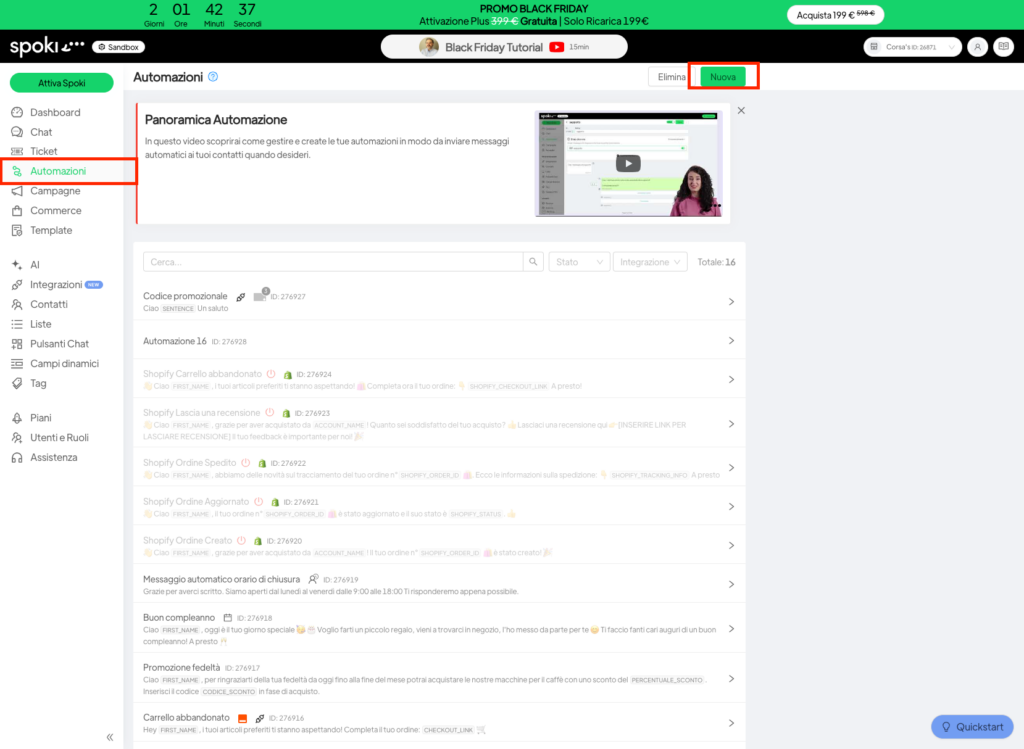
First, navigate to the Automations section as shown below and click on the New button in the upper right corner.
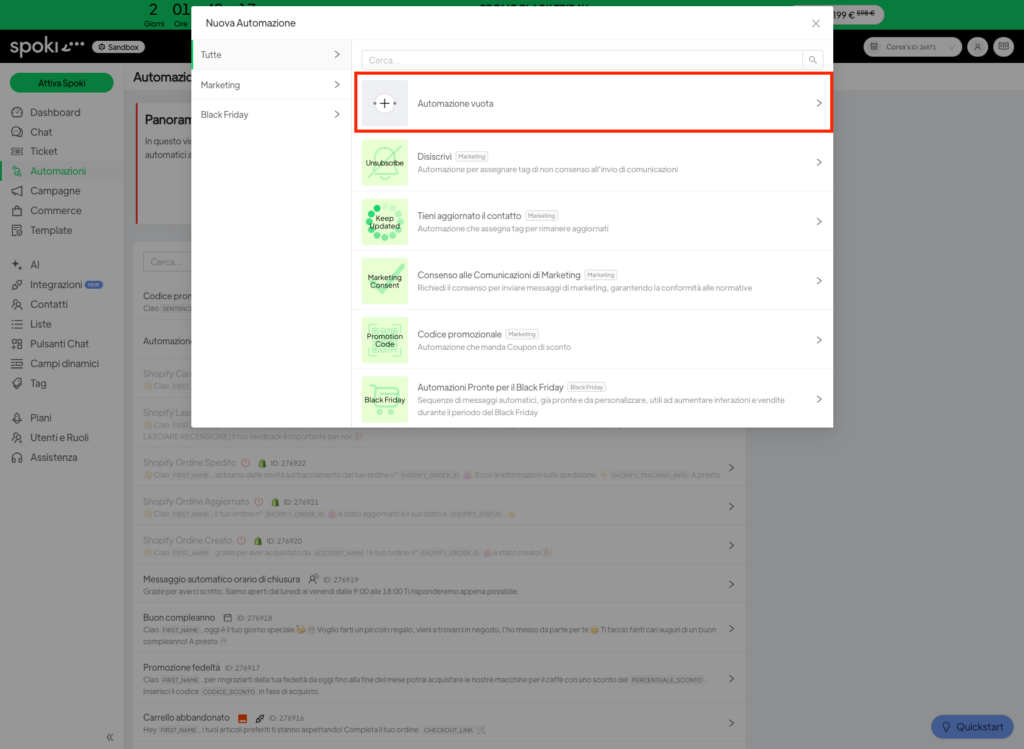
Now choose a template for your automation, or click on Blank Automation if you want to build your automation from scratch.

In the following example, we will start from an empty automation.
1.2 Add the start trigger #

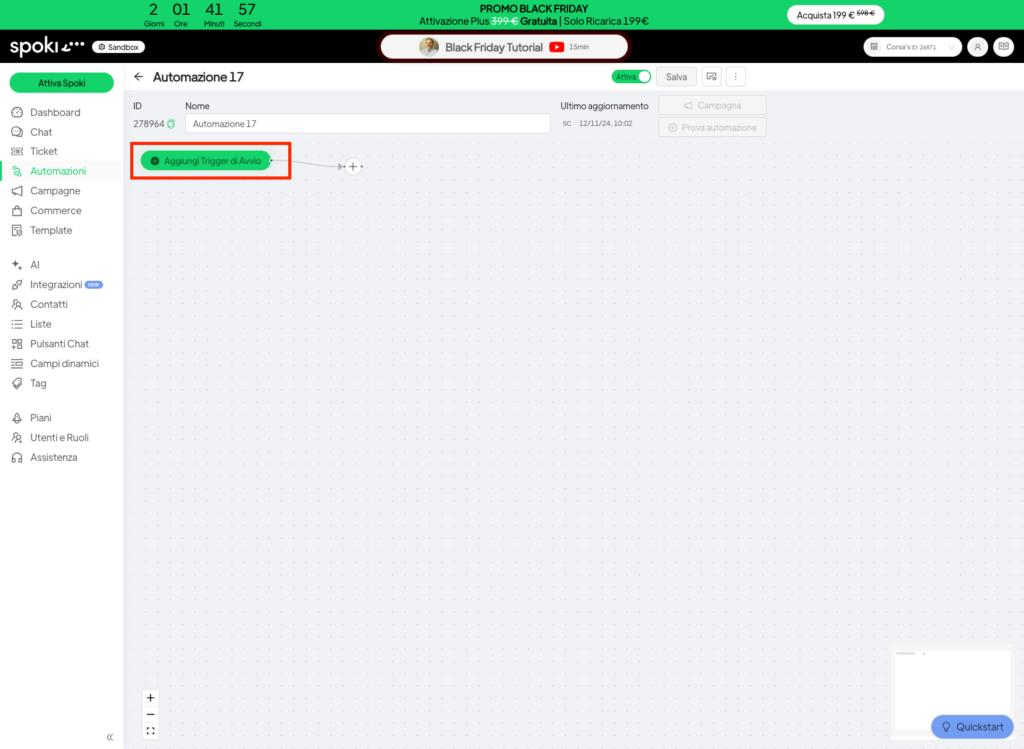
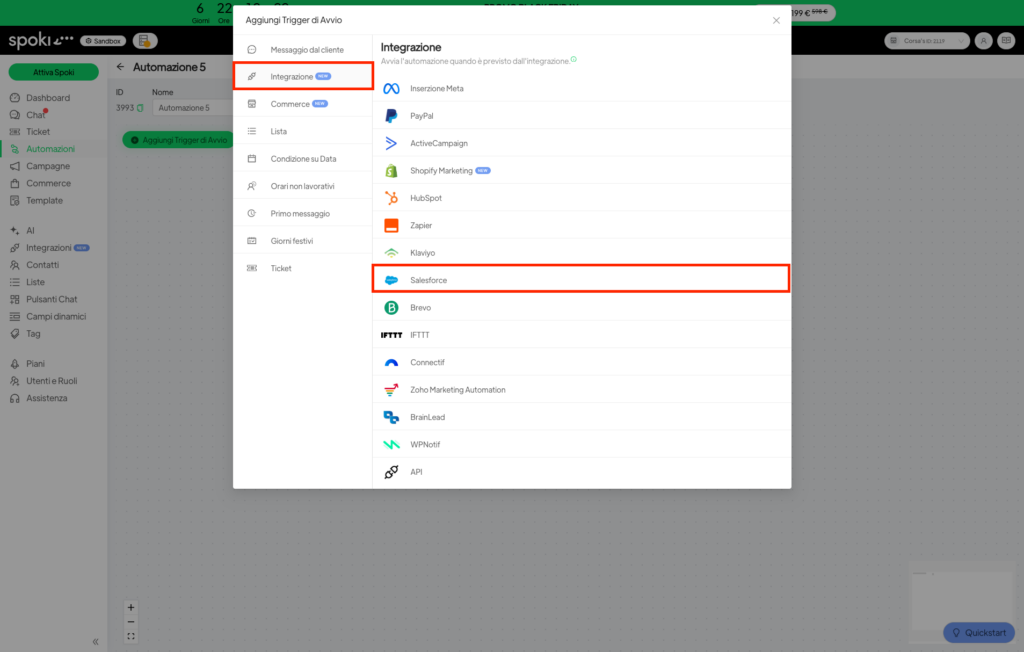
Once your automation is created, click on Add start trigger. In the menu that appears, select Integrations from the list on the left, and finally, click on API.
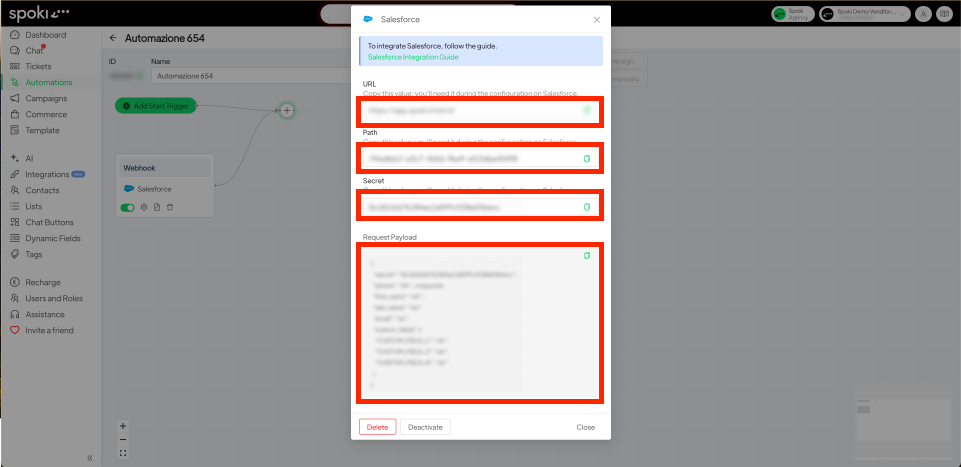
In the window that opens, take note of the URL, Path, Secret, and Payload of the request.
1.3 Add a step to the automation. #

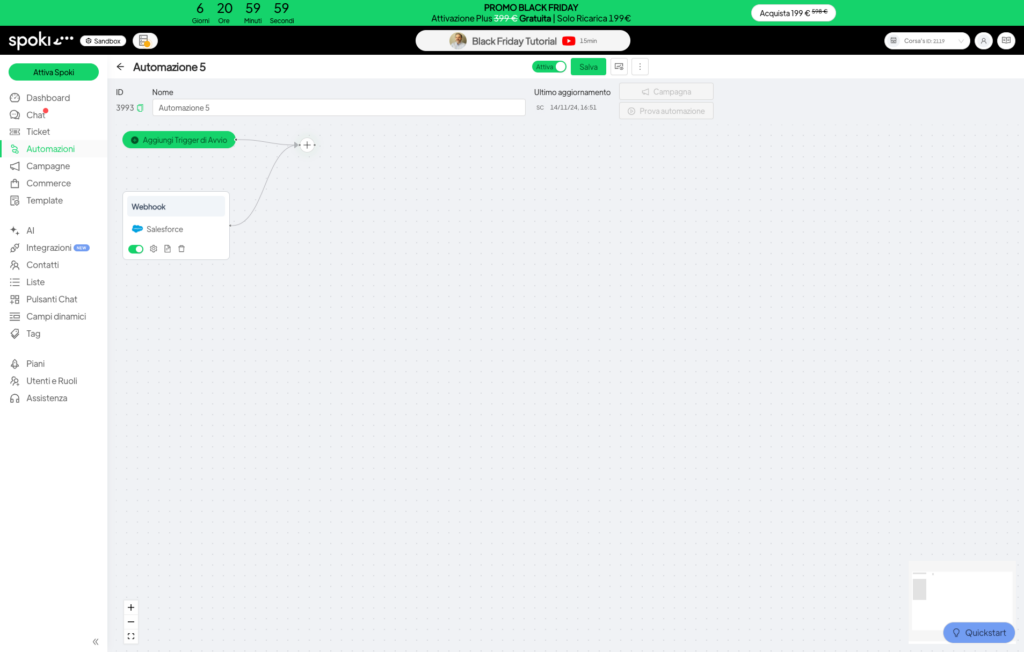
Now it’s time to add a step to the automation. To do this, click on the + inside the automation.
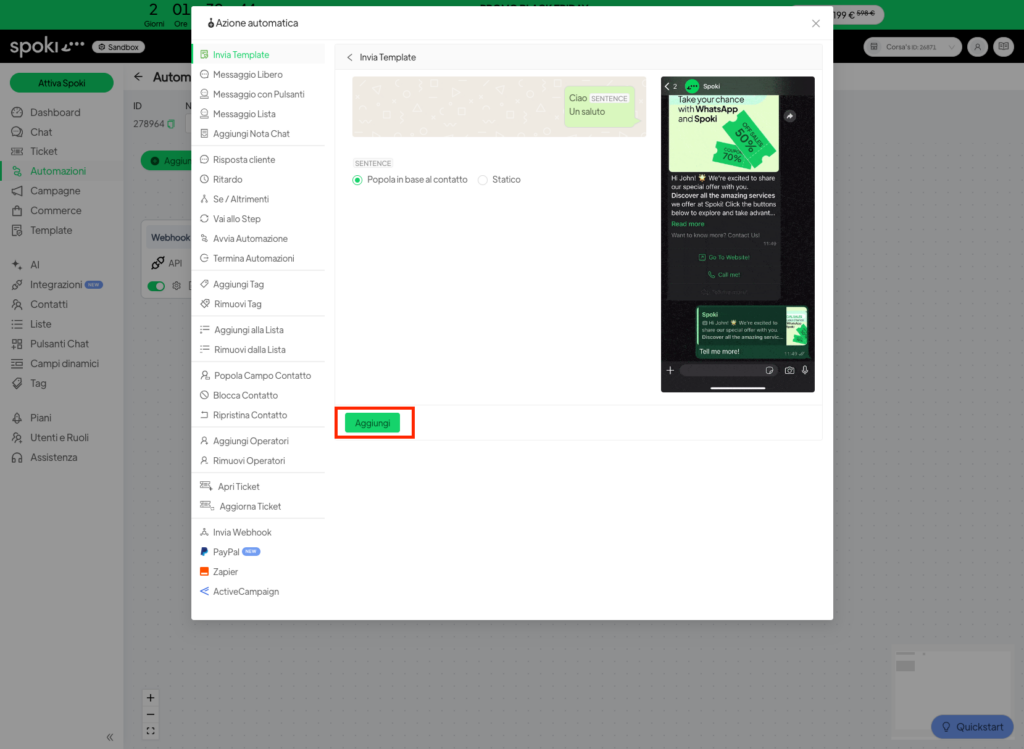
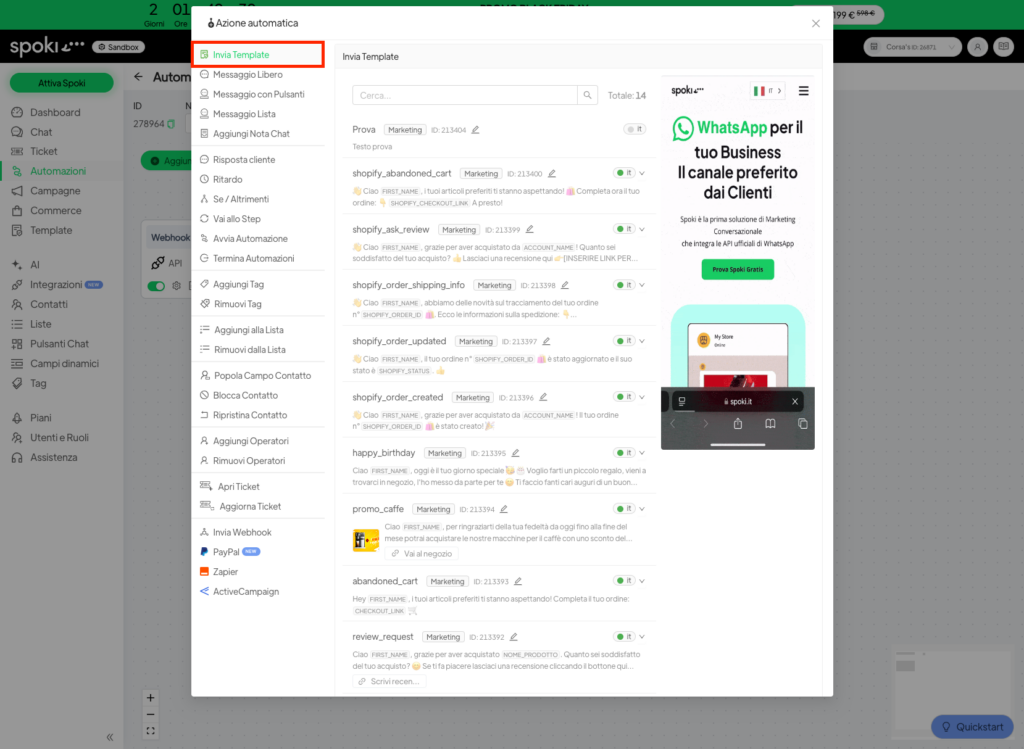
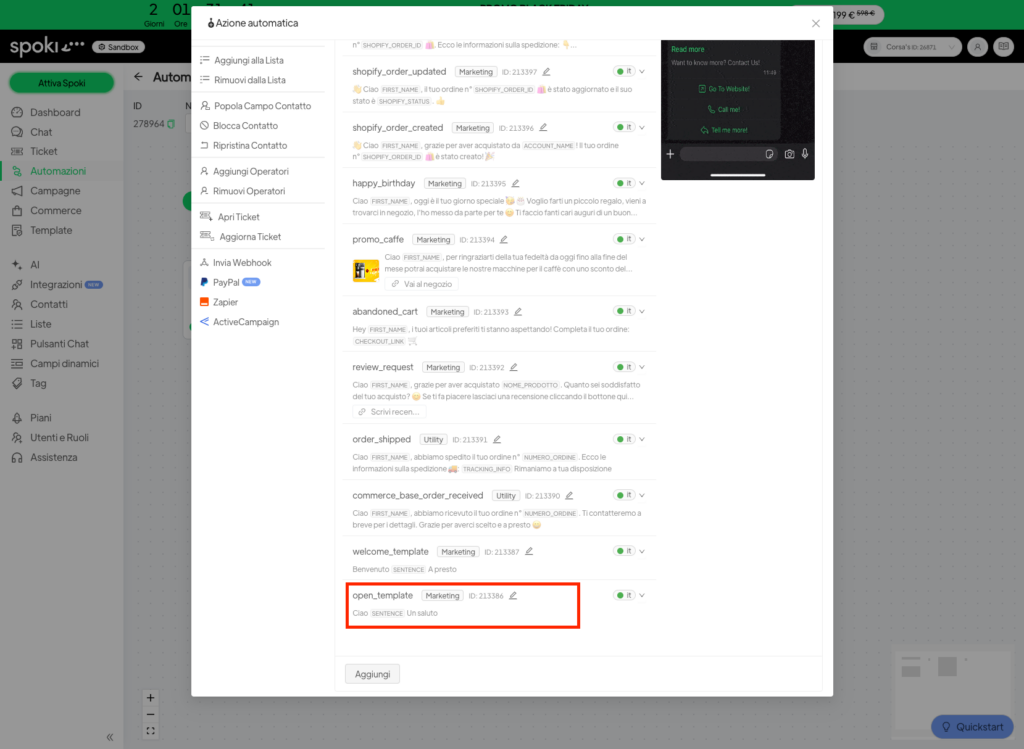
In the window that opens, click on Send Template from the list on the left, select a template from the available options, and click on Add.
Now you’re ready to move to Salesforce.

2. Salesforce Flow #

If you haven’t done so already, log in to your Salesforce account.

2.1 Webhook configuration in Salesforce. #

2.1.1 Creation of Named Credentials #

Once logged into Salesforce, click on the ⚙️ icon at the top, then select Setup. From the list on the left, click on Security, and then on Named Credentials.
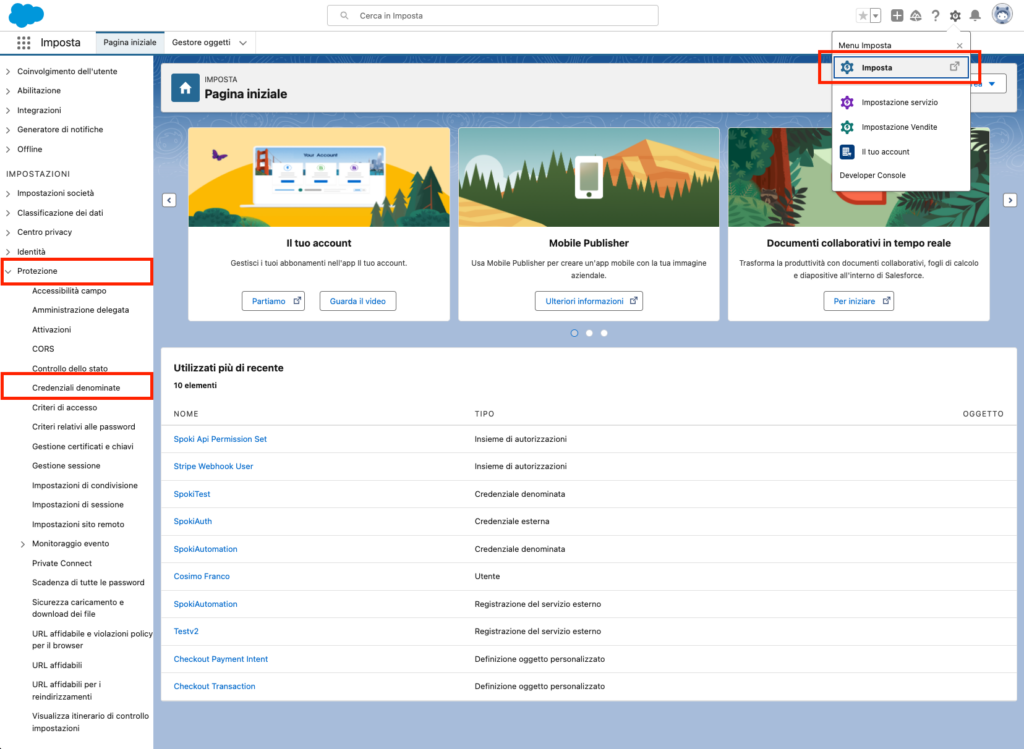
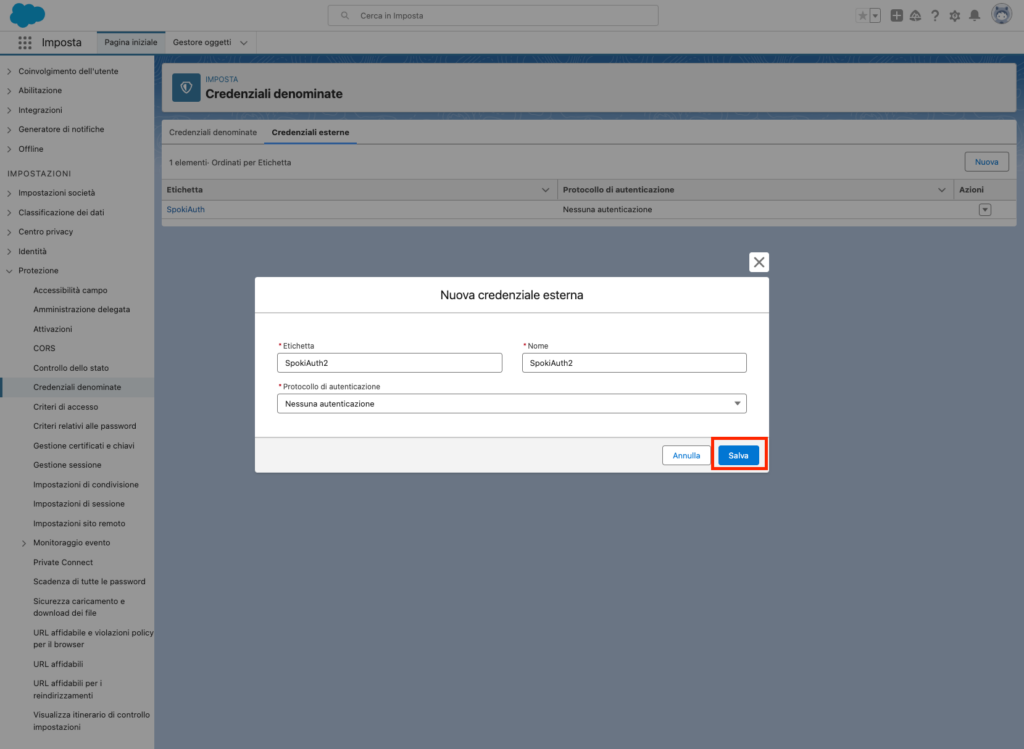
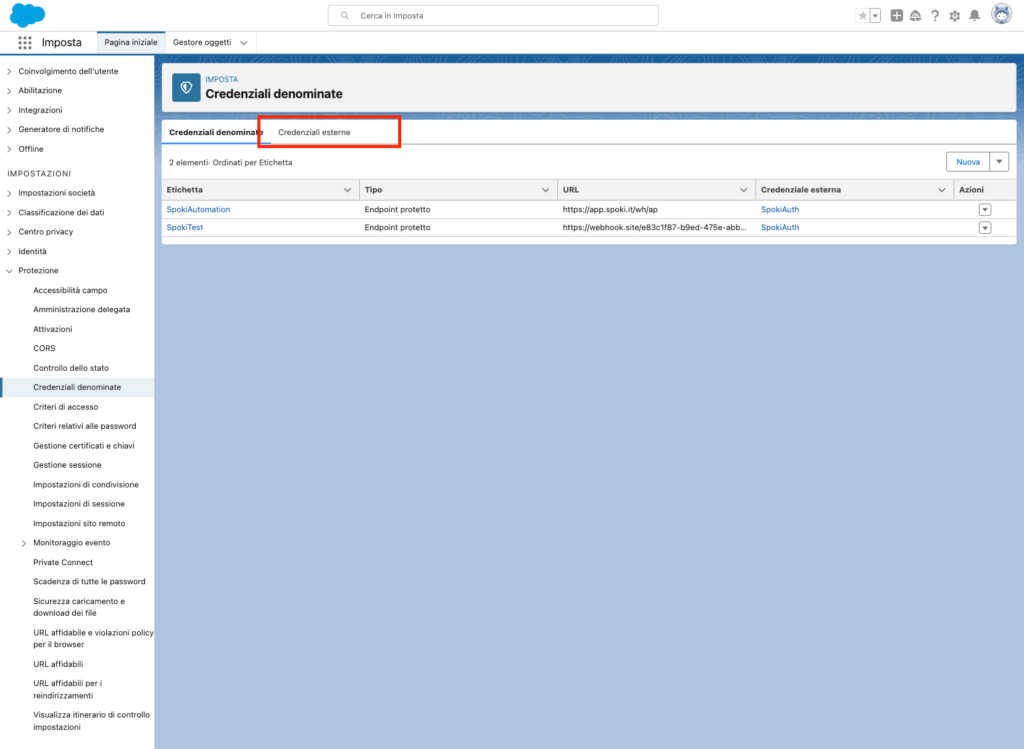
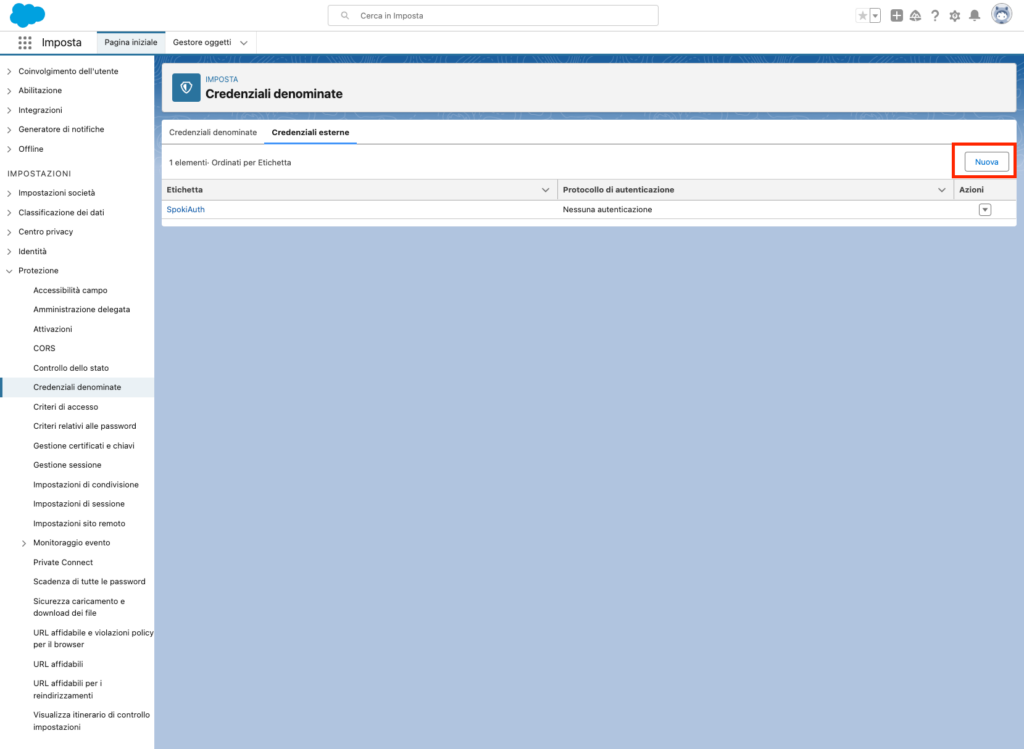
In the screen that opens, click on External Credentials and then on New

Enter a label and a name for the new credential, set the Authentication Protocol to No Authentication, and finally, click Save.
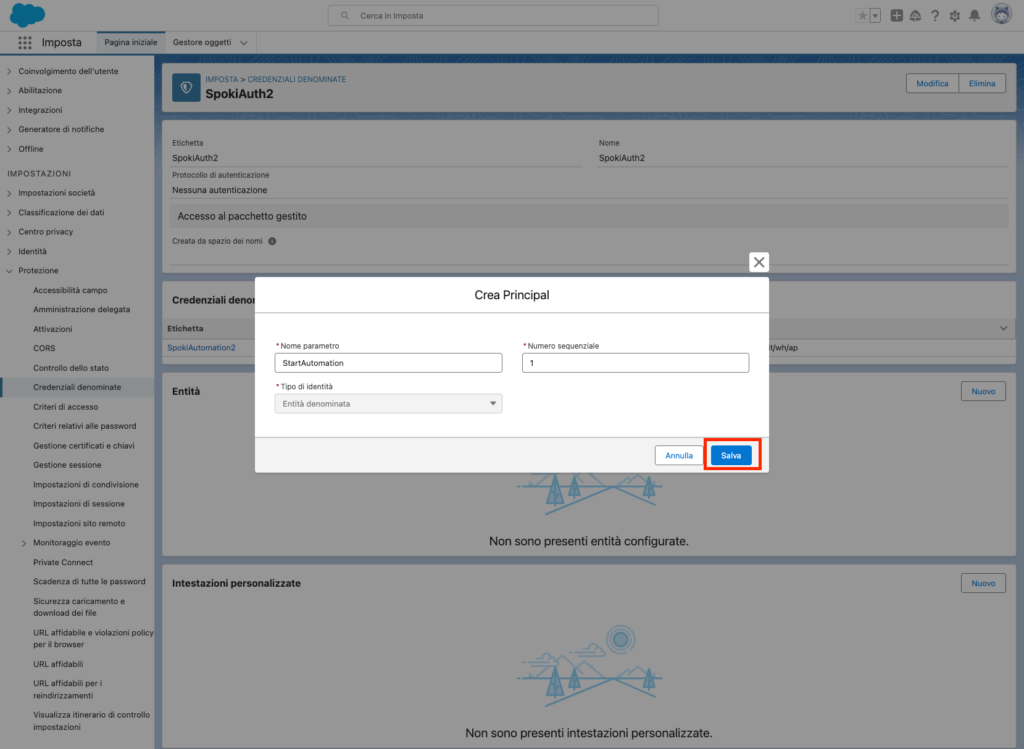
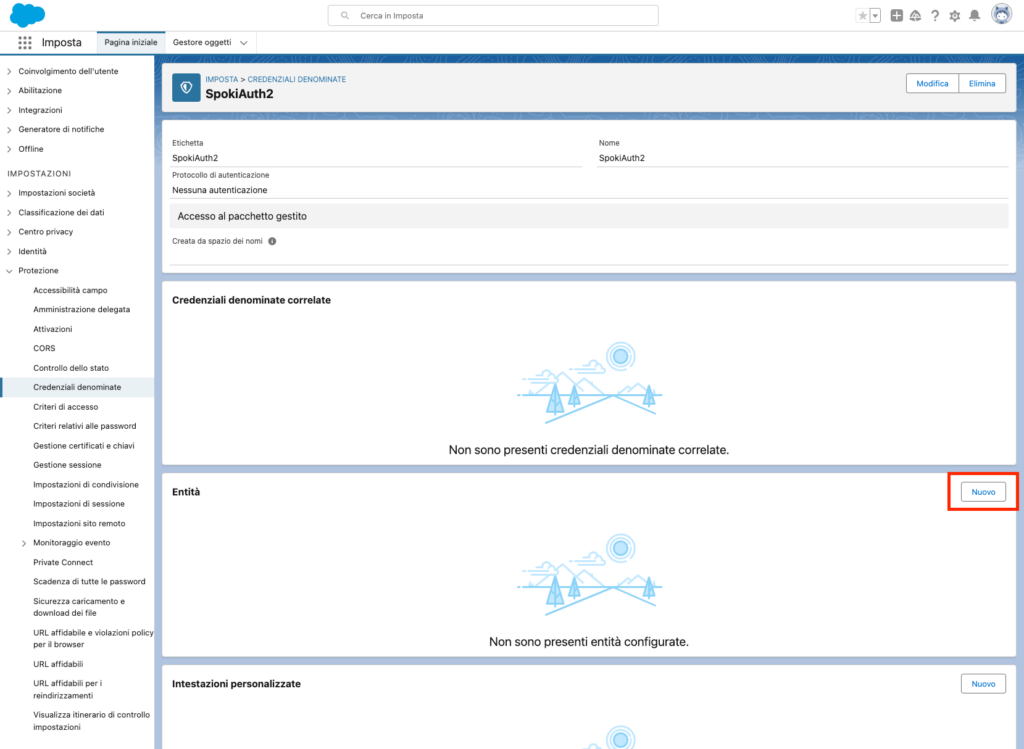
Now we need to create a new entity. In the current screen, go to the Entities section and click on New

Enter a parameter name and a sequential number, then click Save
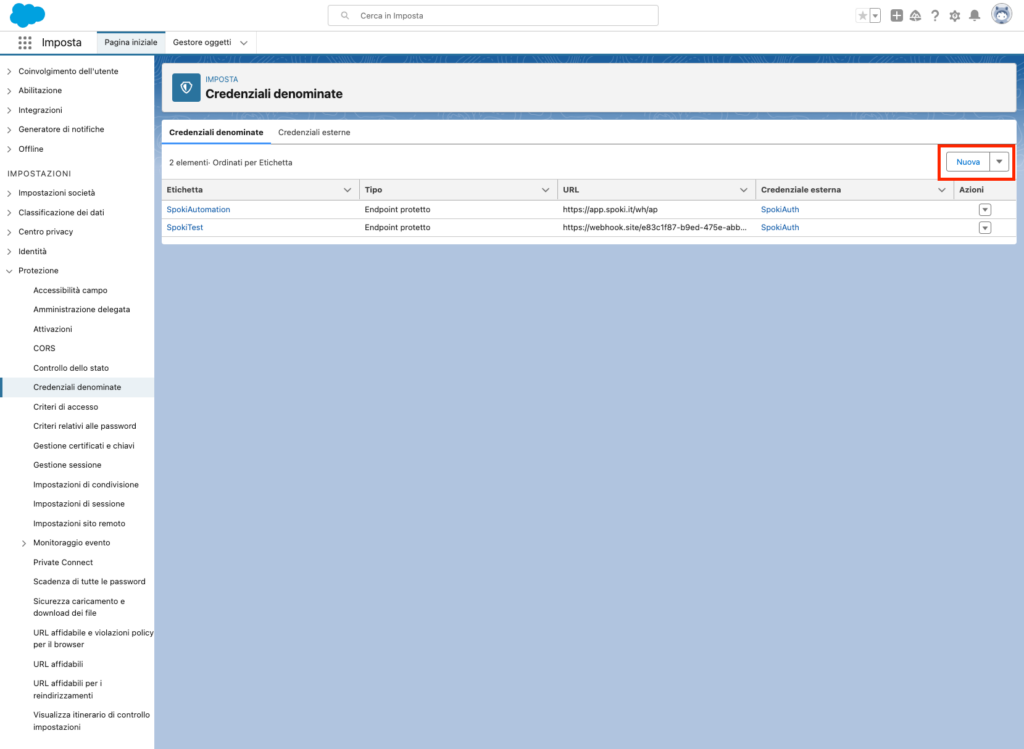
Now click on Named Credentials at the top, and then click on New.
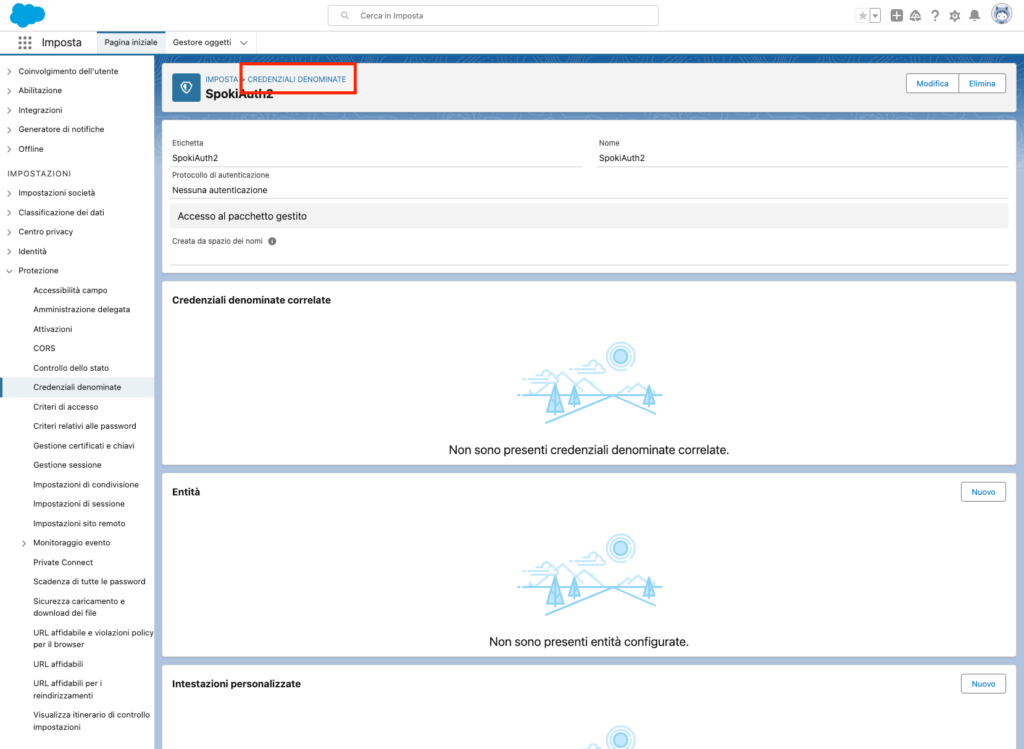
In the screen that opens, enter values for the Name and Label fields. In the URL field, insert the URL parameter provided by Spoki during the automation setup. In the External Credential field, select the external credential you previously created. Make sure to check all 3 checkboxes, then click Save.
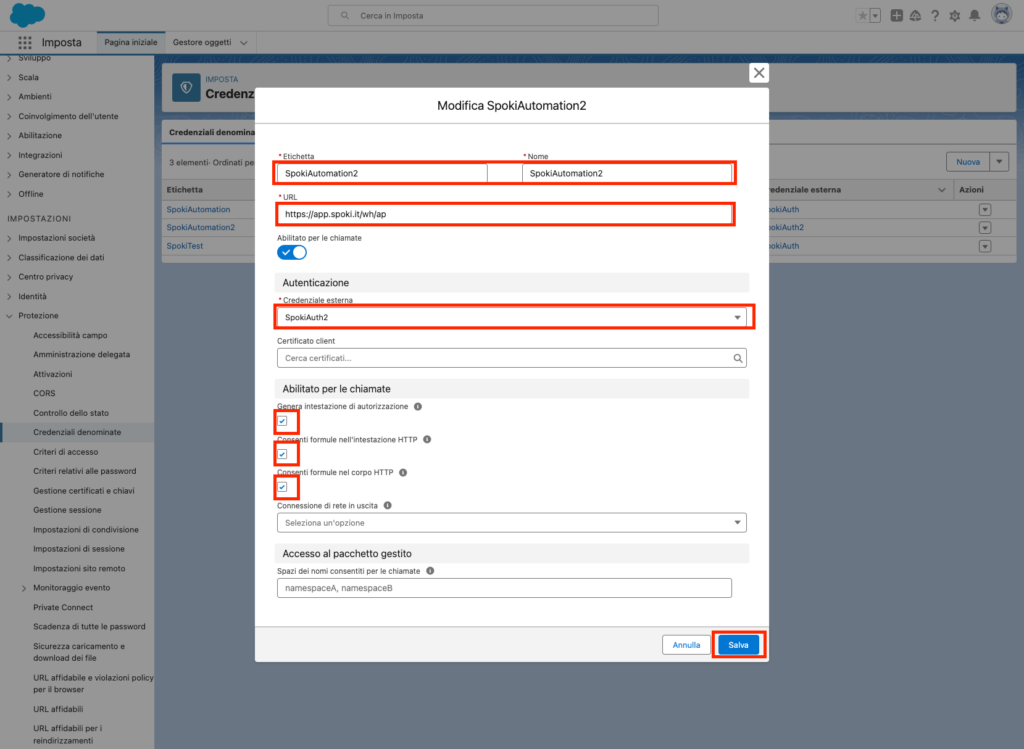
2.1.2 Creating Permissions to Use Named Credentials #

From the list on the left, click on Users and then on Permission Sets. In the screen that opens, click on New.
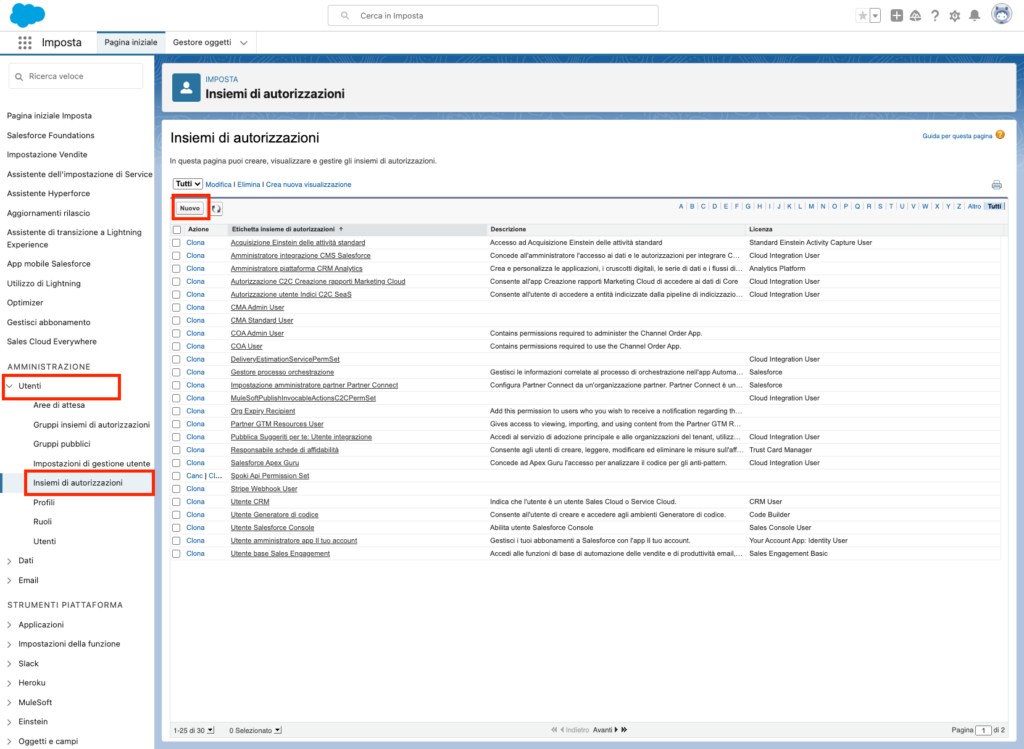
Enter a value in the Label and API Name fields, then click Save
Now click on Manage Assignments, and then on Add Assignment
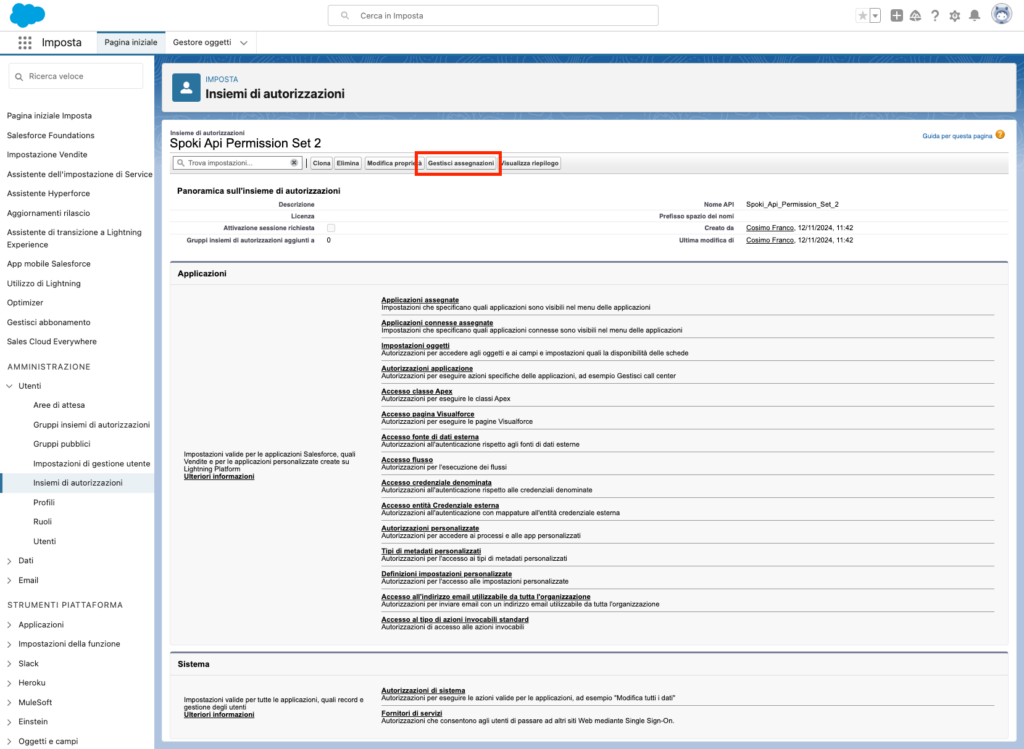
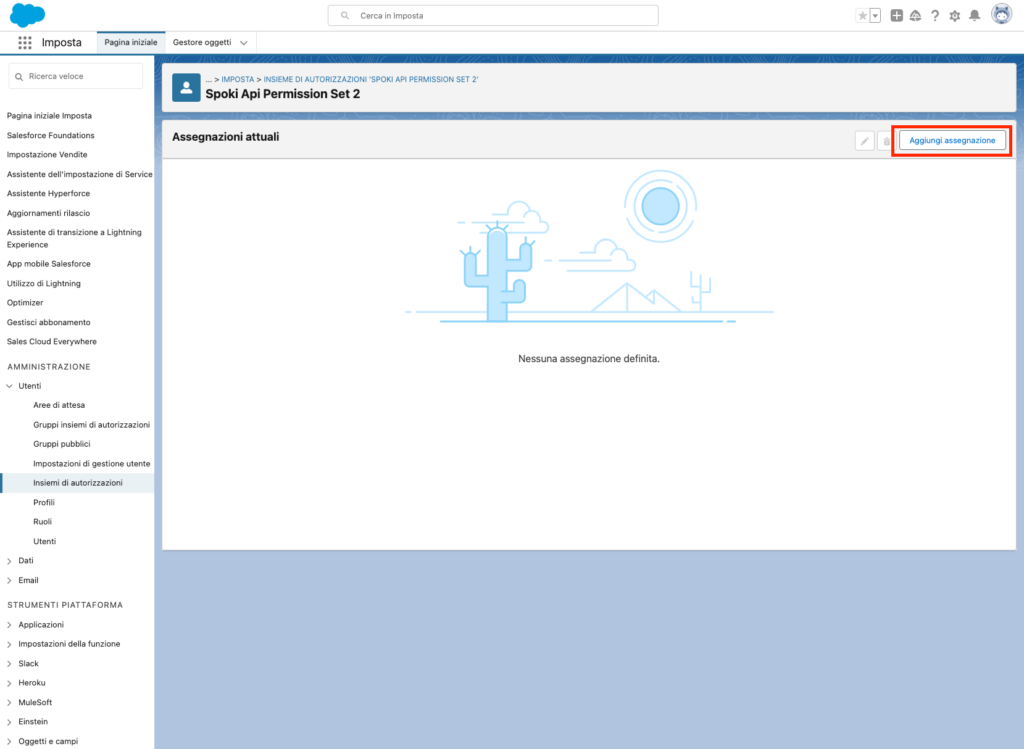
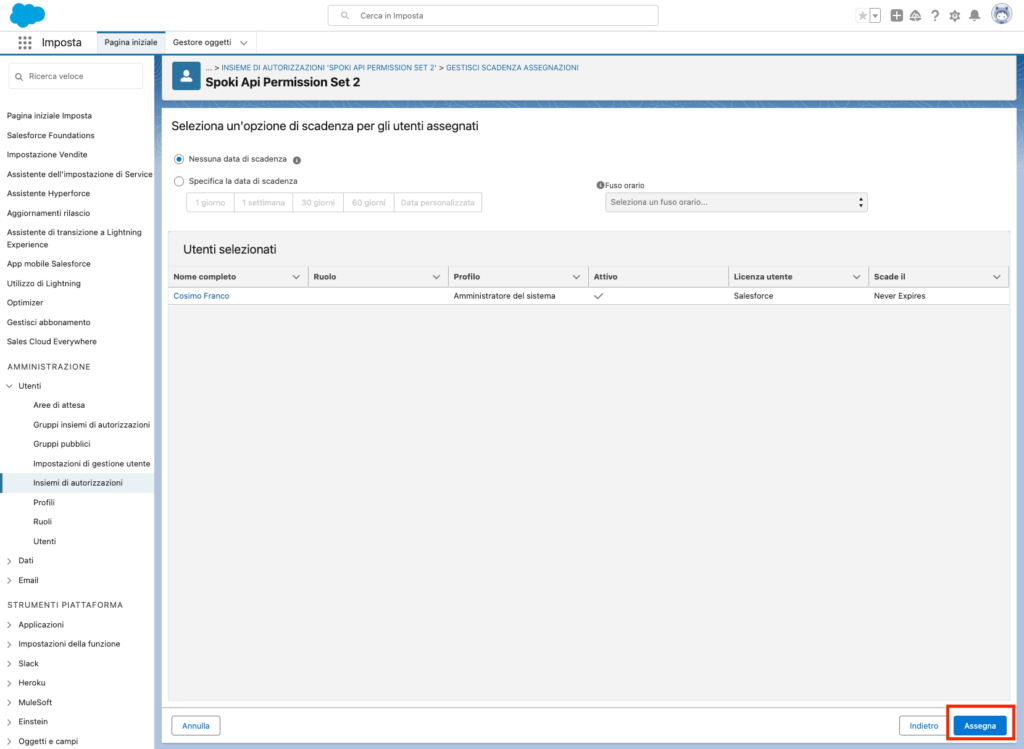
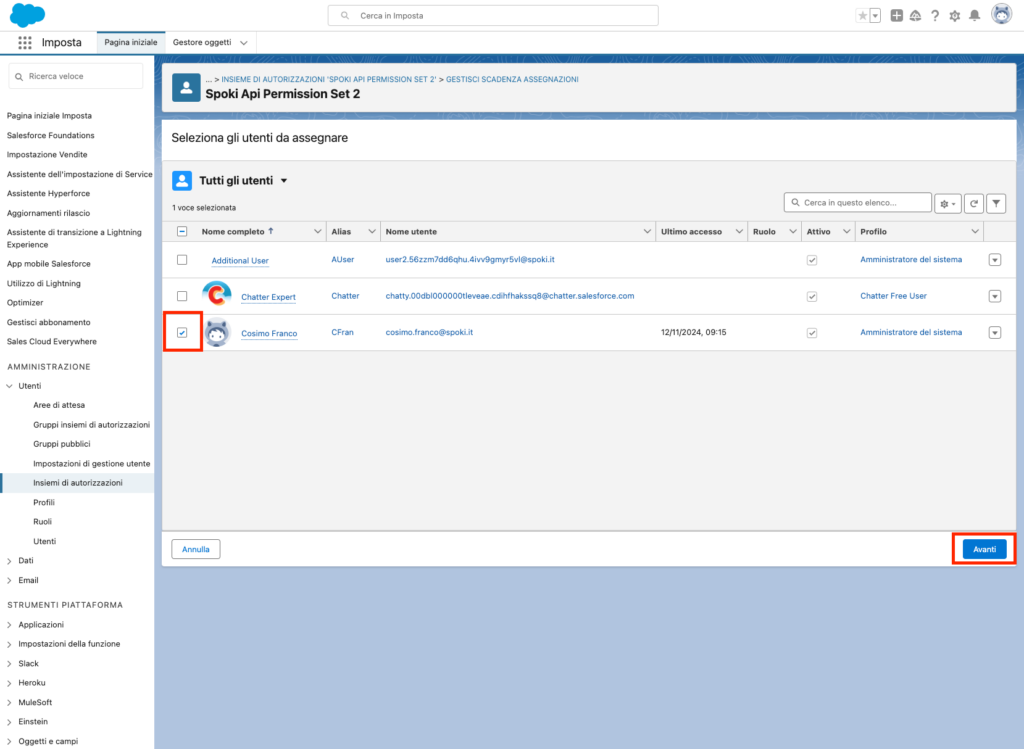
Select from the list the users who will have the permissions to use and create Flows utilizing the named credentials created earlier.

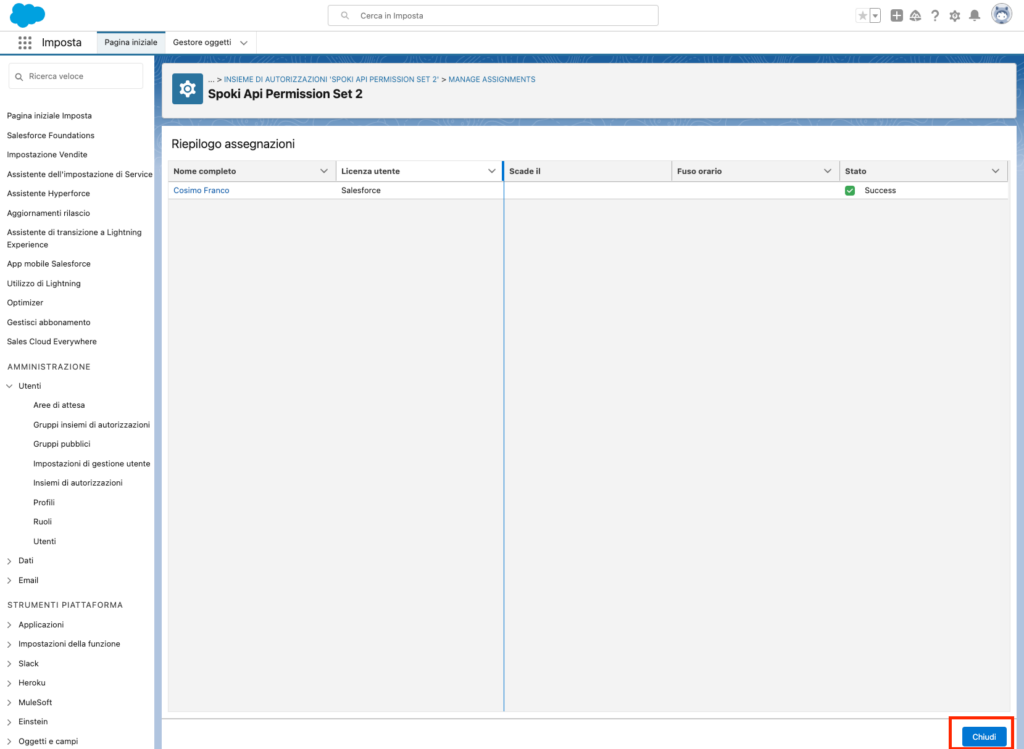
Then click on Next, Assign, and finally Done.
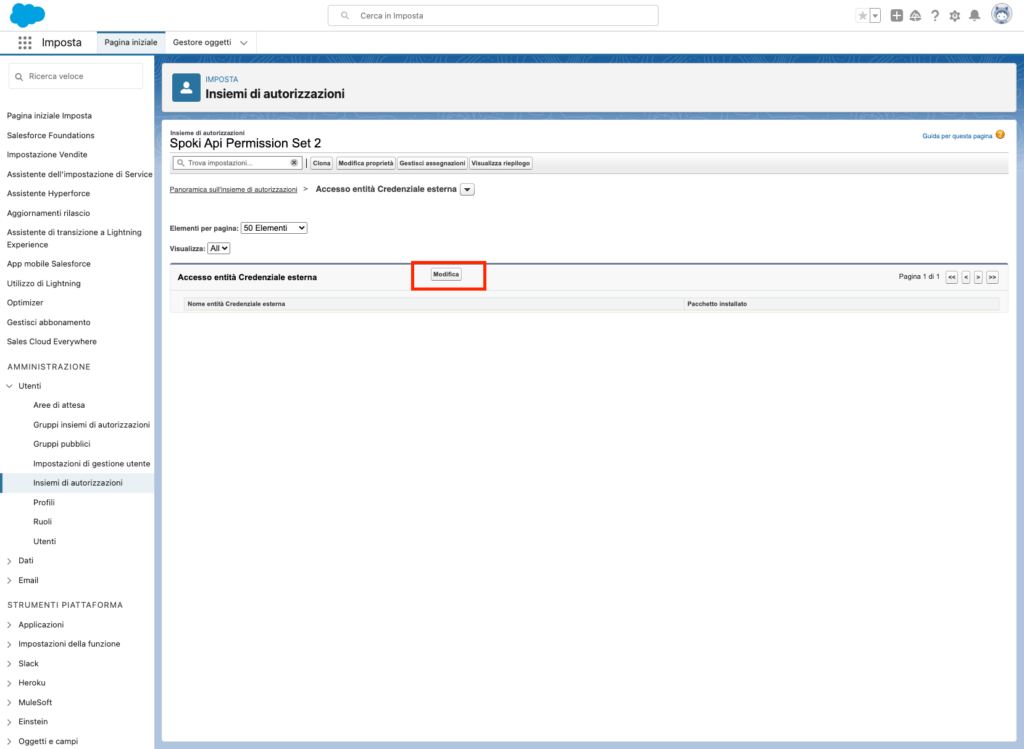
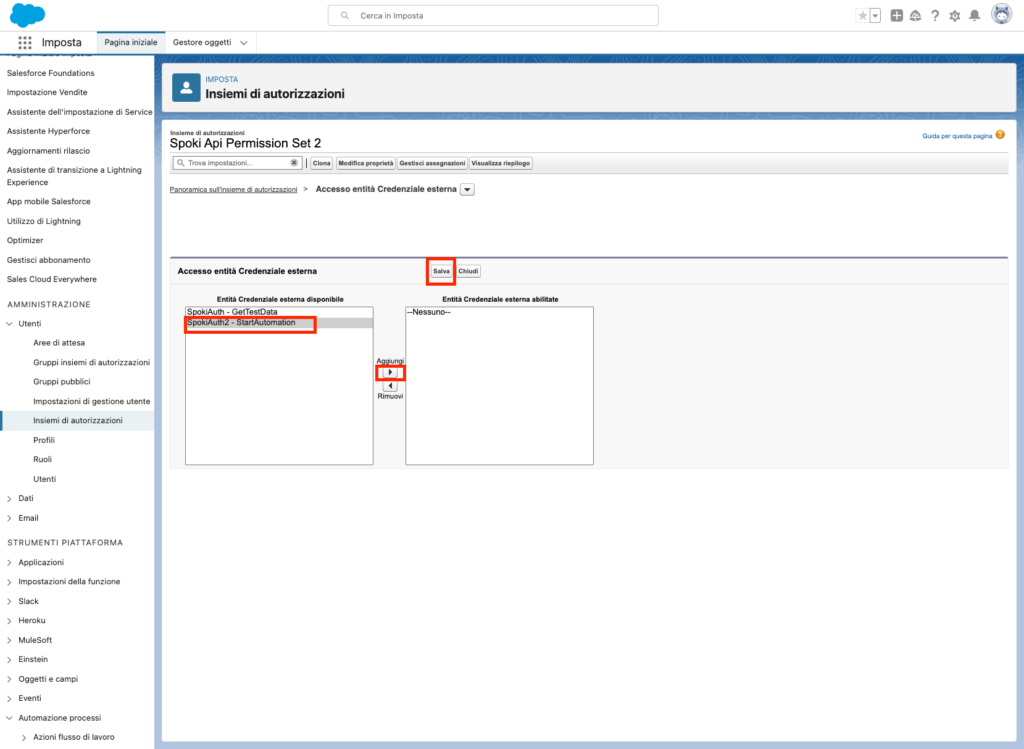
Now click on External Credential Object Access, and then click on Edit.
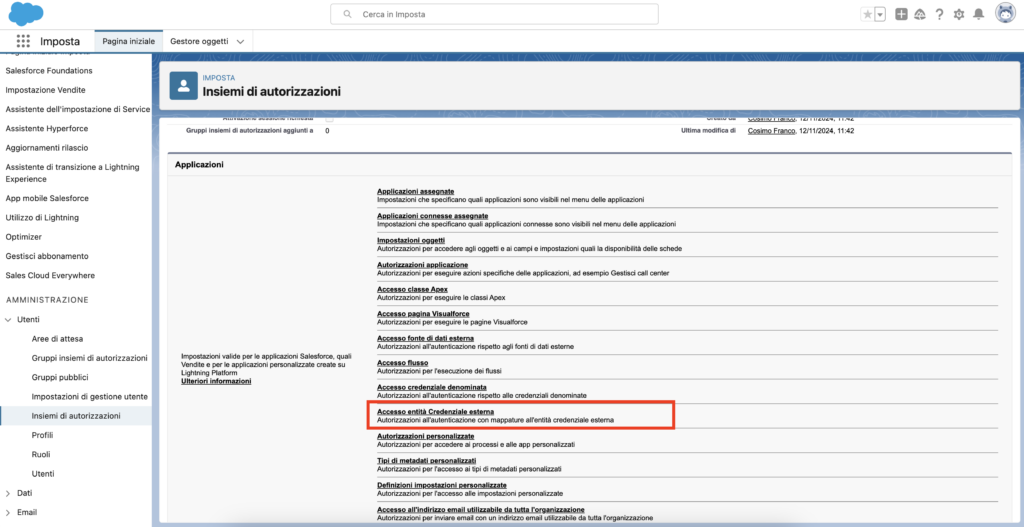
Select the external credential you created earlier, then click the Add button to include it in the list of enabled credentials. Finally, click Save
2.2 Salesforce Flow #

2.2.1 Creating a Salesforce Flow #

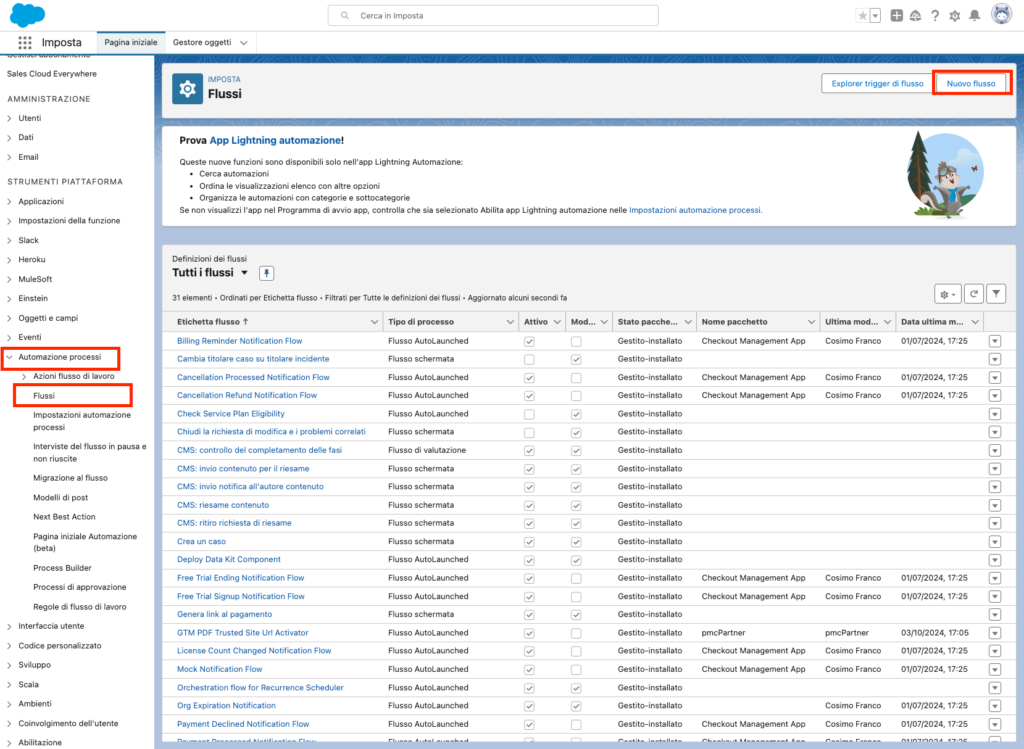
From the list on the left, click on Process Automation and then Flows. To create a new flow, click on New Flow at the top right.
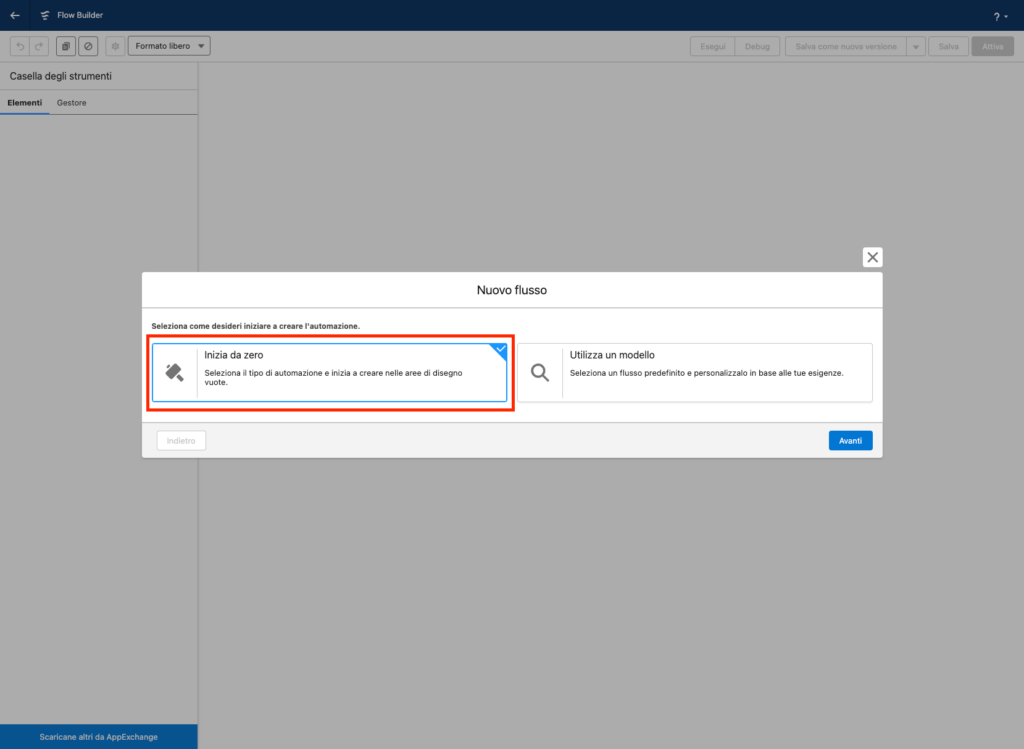
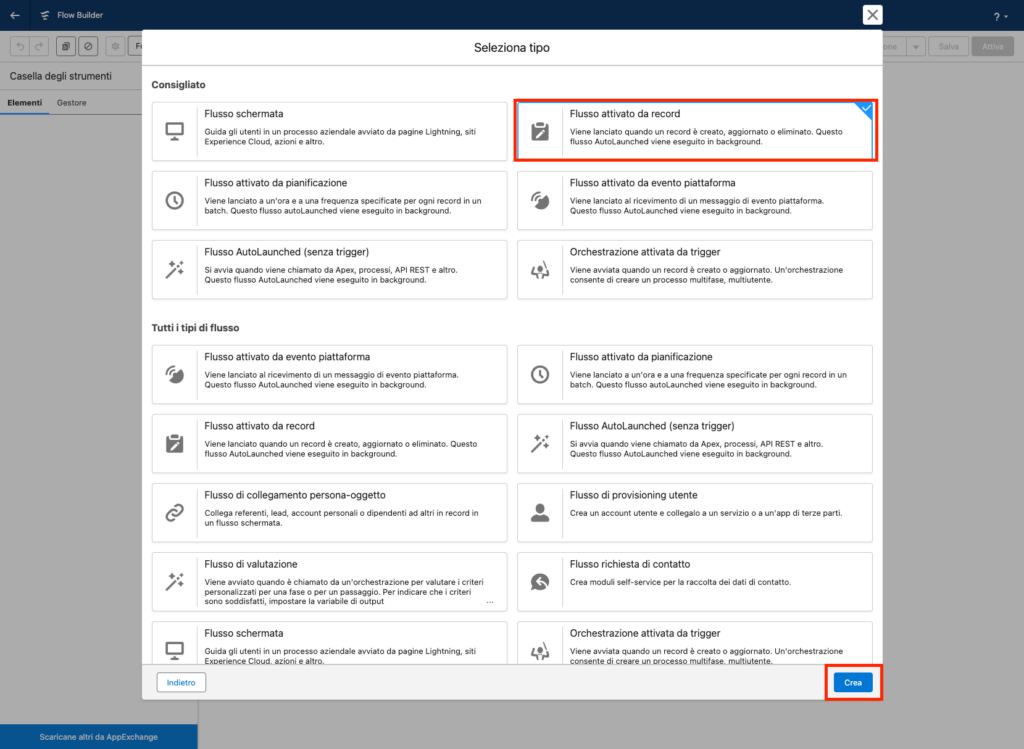
In the screen that opens, click on Start from Scratch and then select Record-Triggered Flow.
Select the type of Object to be monitored when it is created or updated. In this example, we’ll select the Lead object.

Select the option A record is created or updated
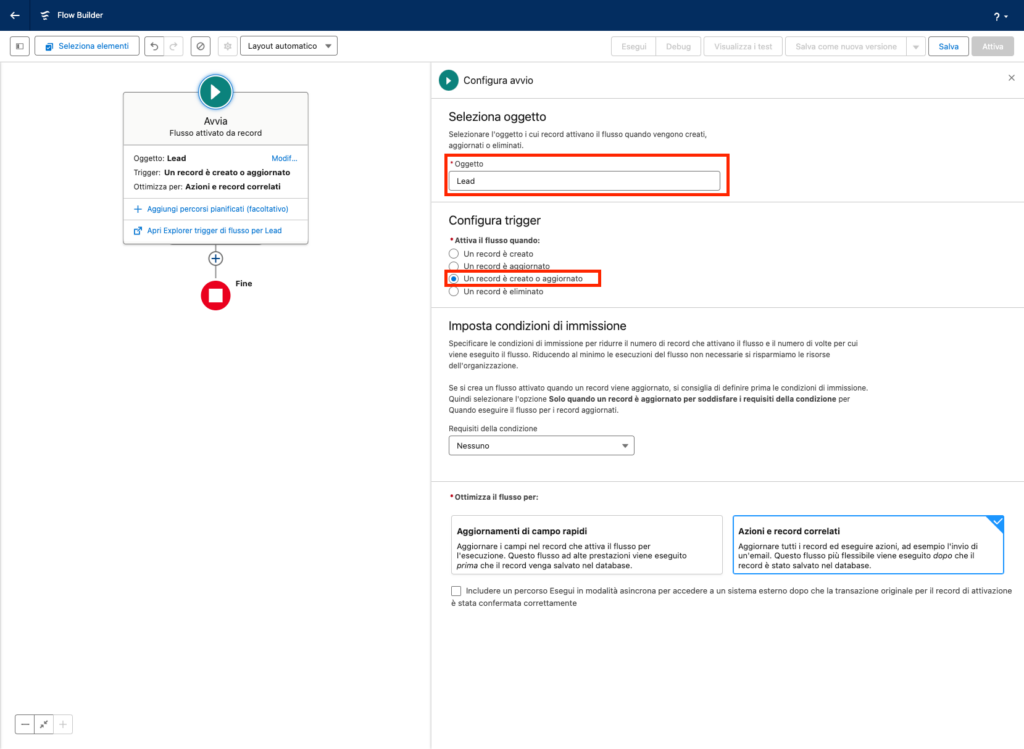
Click on Add Scheduled Paths
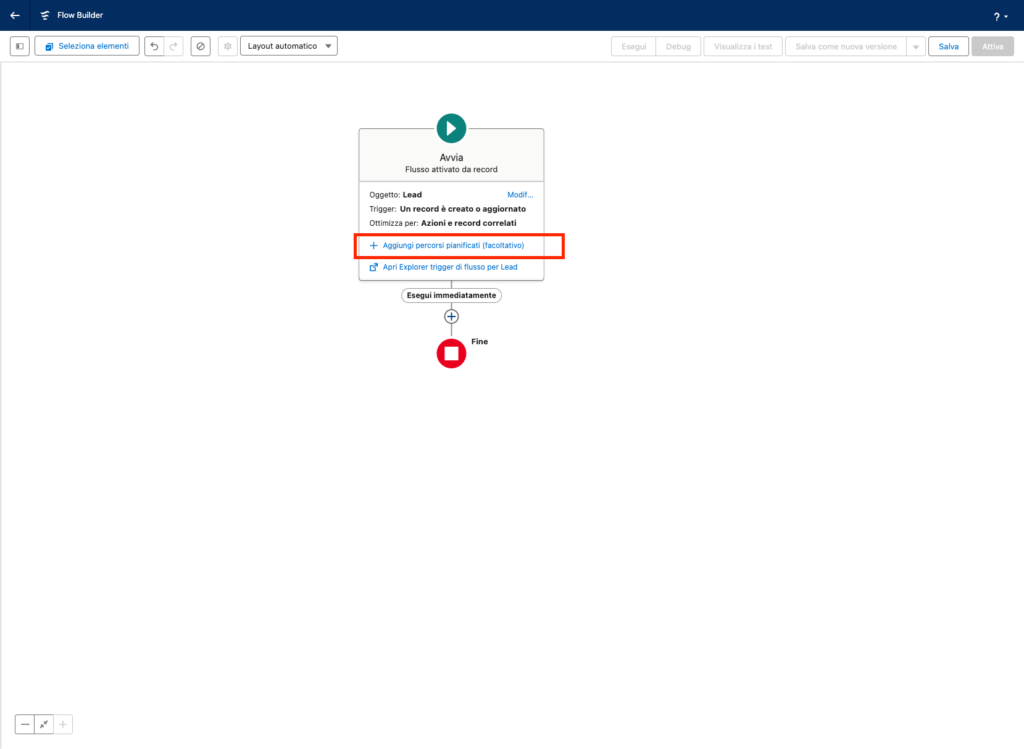
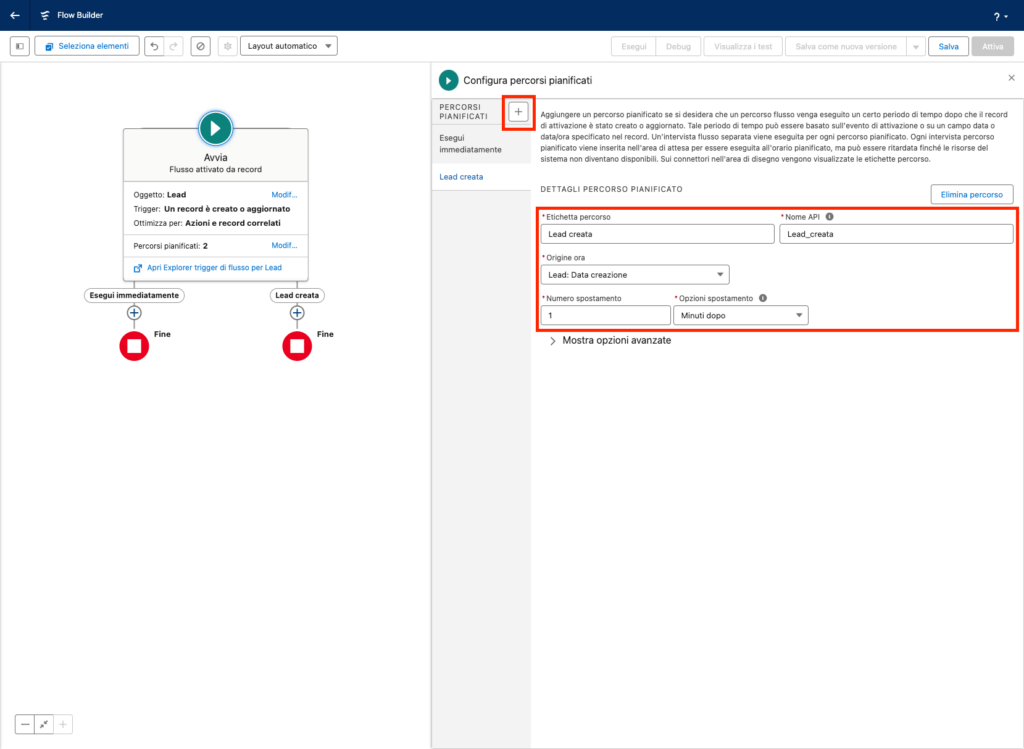
Enter a name for Path label and a name for API Name
Enter Lead: Created Date for the Set the Time Source field.
Enter 1 in the Offset Number field and select Minutes After in the Offset Options field
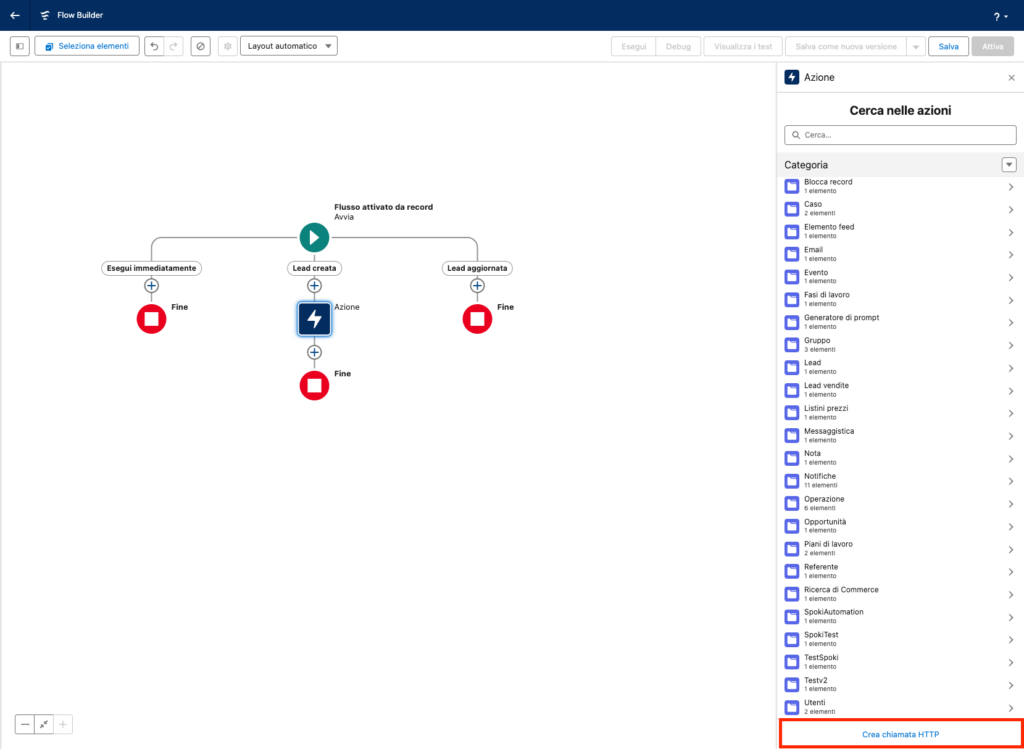
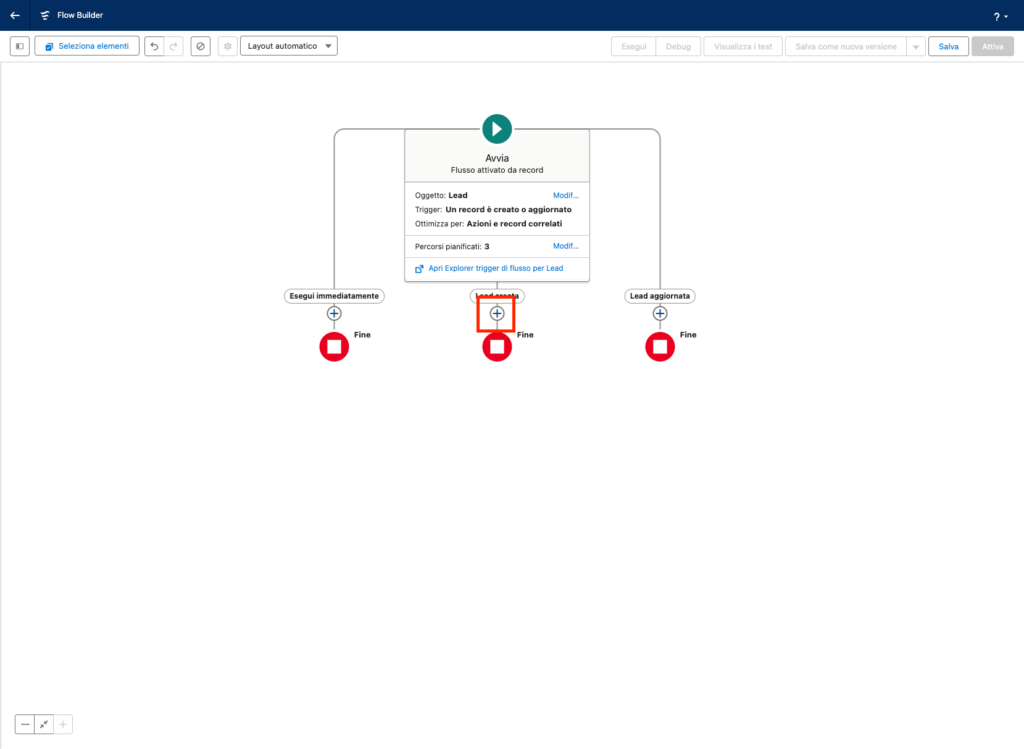
This way, we’ve created a path that triggers 1 minute after a Lead is created. Now, let’s create a path for when the Lead is updated. Click on the + in the top left corner.
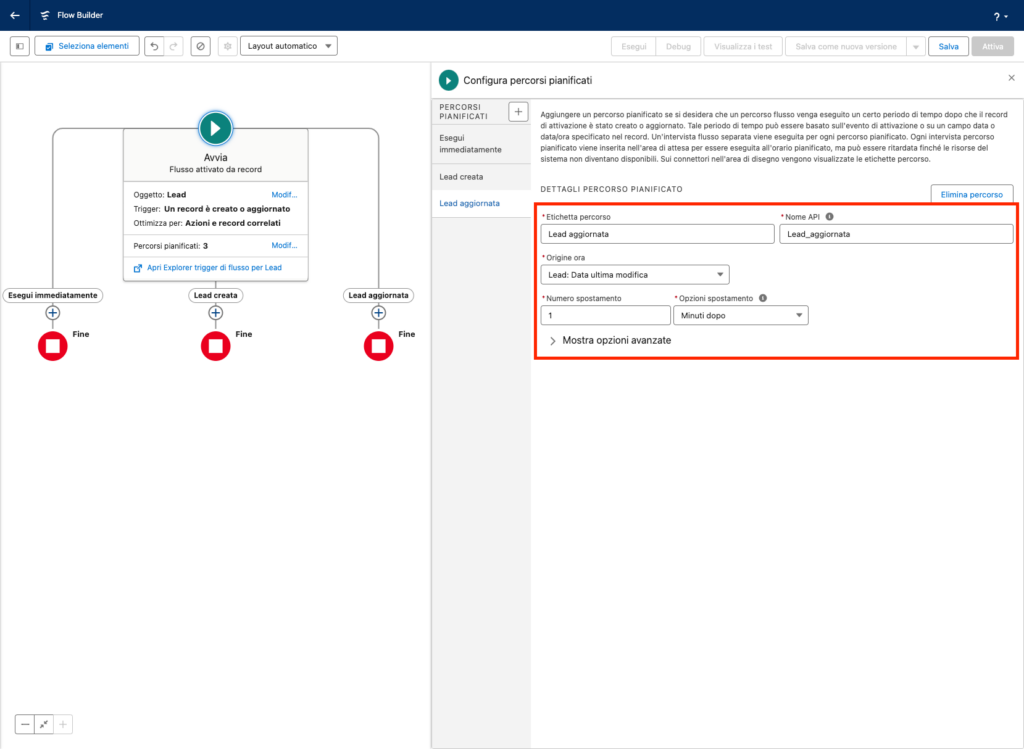
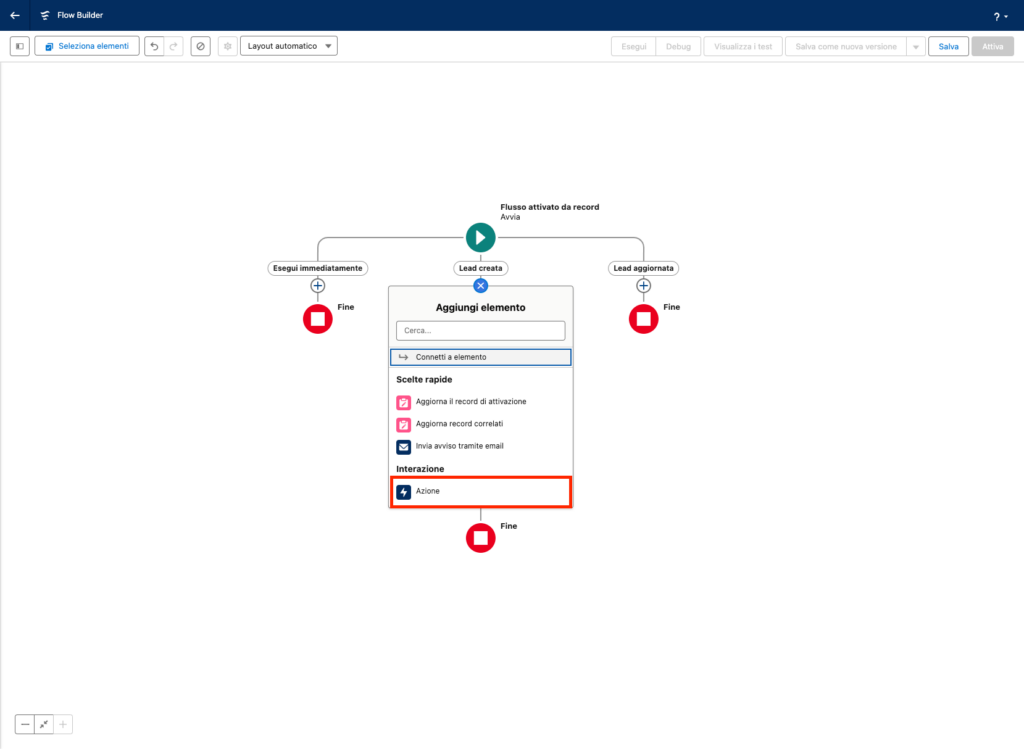
At this point, click the + inside the Lead Created path and select Action. Then, click the Create HTTP Call button at the bottom right.
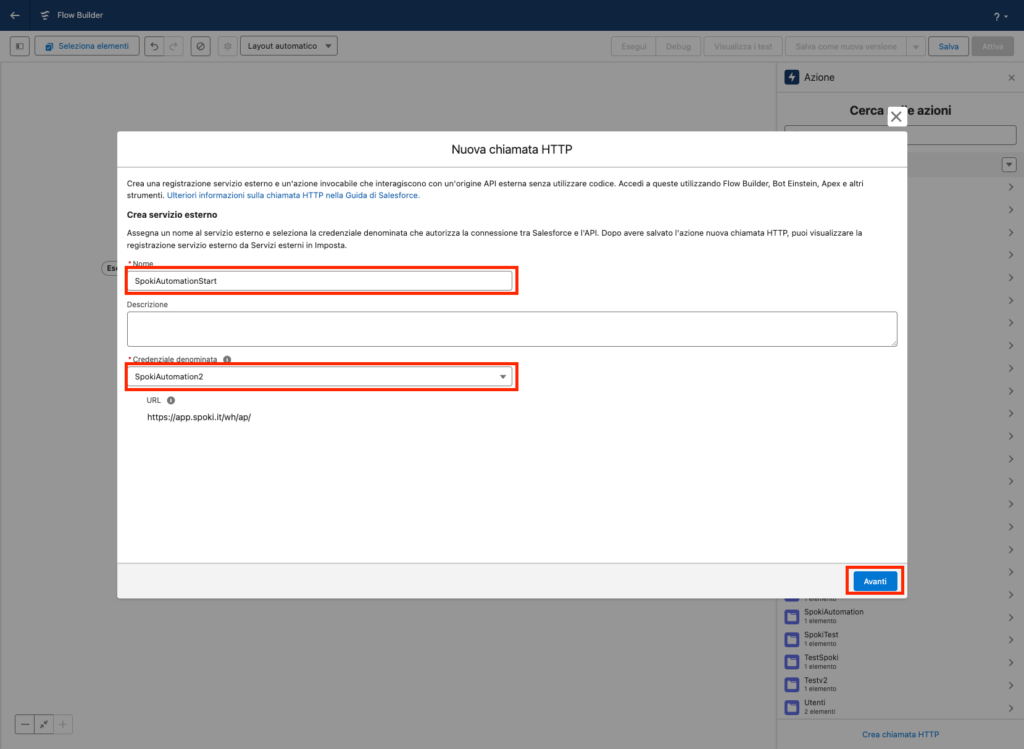
Enter a name for the HTTP Call and select the Named Credential you created earlier. Then, click Next.
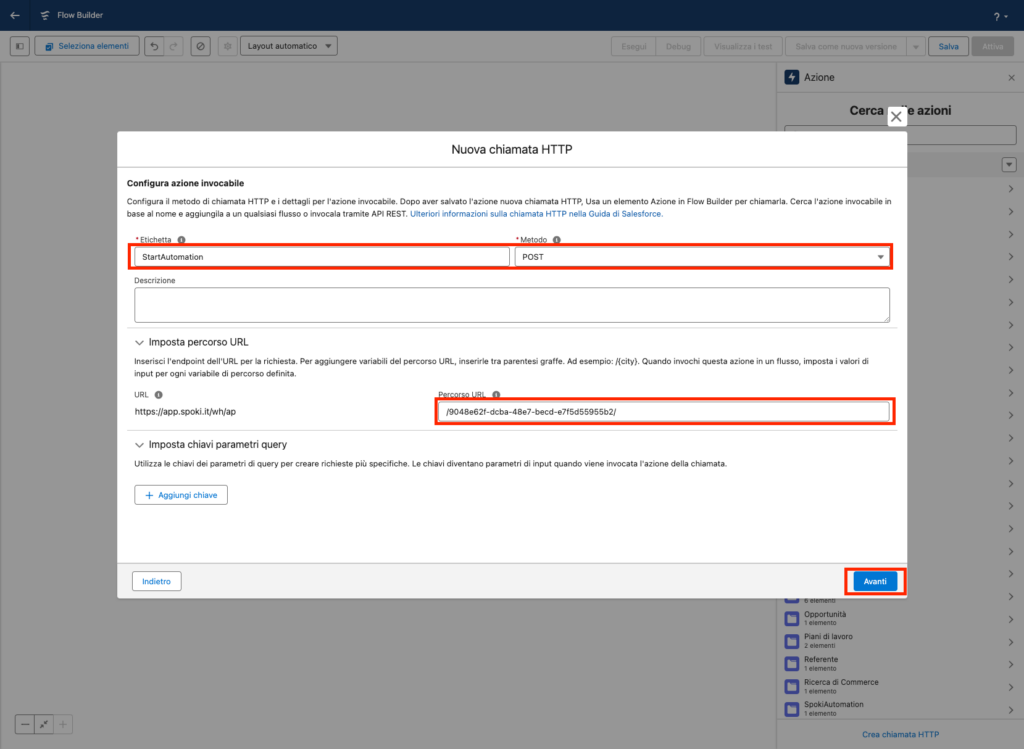
Enter a value in the Label field and select the POST method from the dropdown menu next to Method.
In the URL Path field, insert the Path value provided by Spoki during the automation setup

Note: Make sure that the path starts with the character /

Click on Next
In the Sample JSON Request field, paste the payload provided by Spoki during the automation setup

Note: The payload below has been modified by removing unnecessary fields like first_name, last_name, and email. Additionally, update the names of the custom_fields with the names of the custom fields you configured in the Spoki template associated with the automation

Next, click on Review and then on Next.
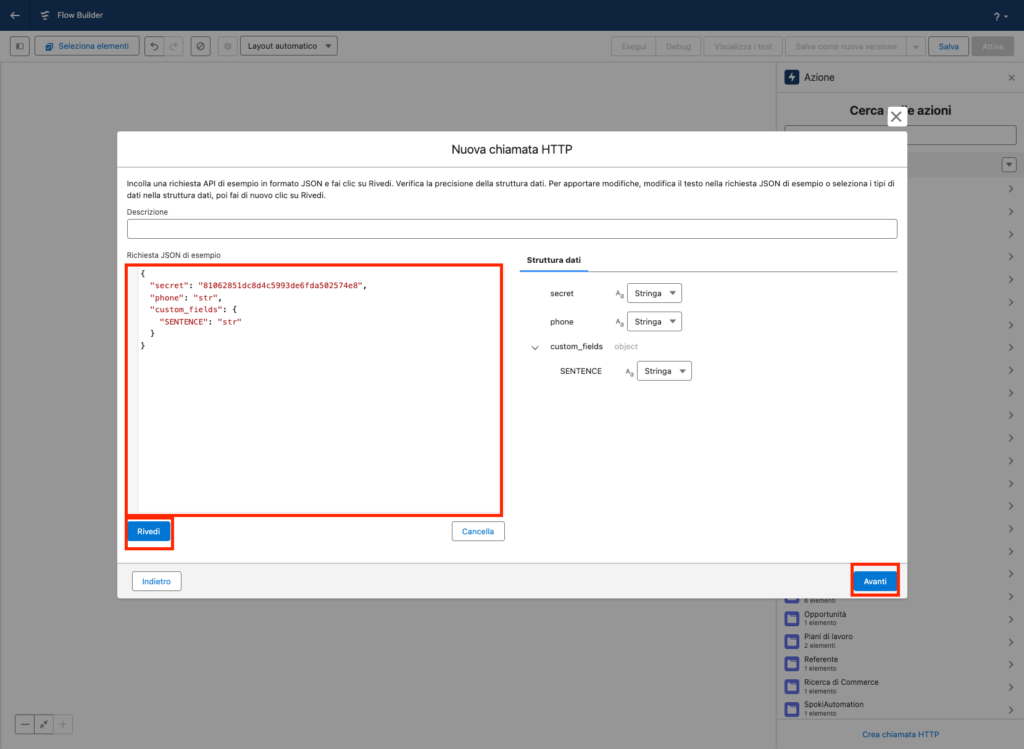
Click on Connect by Schema and then Next
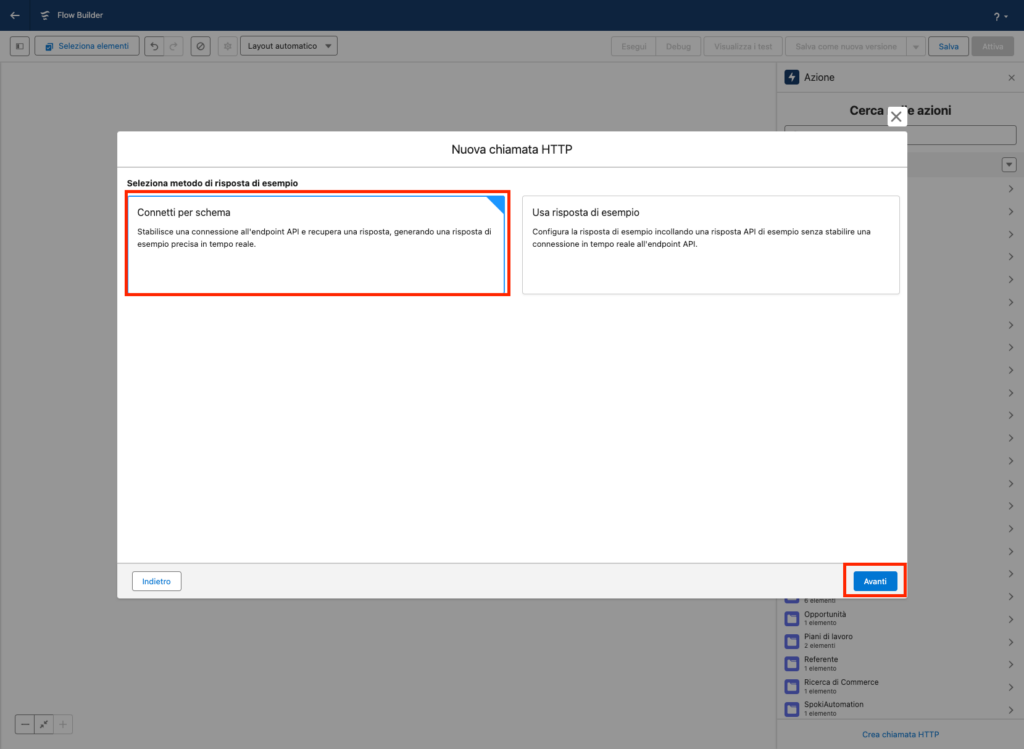
Click on Connect and then click Save
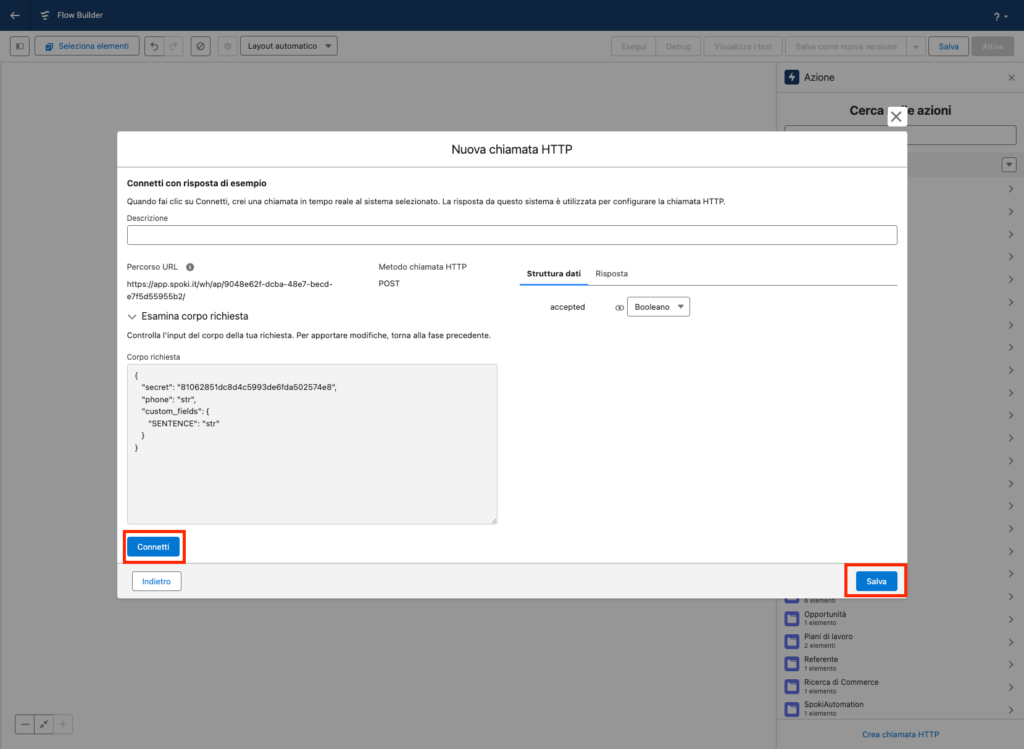
Click on Enter value or search for resources…, and then click on Create Resource
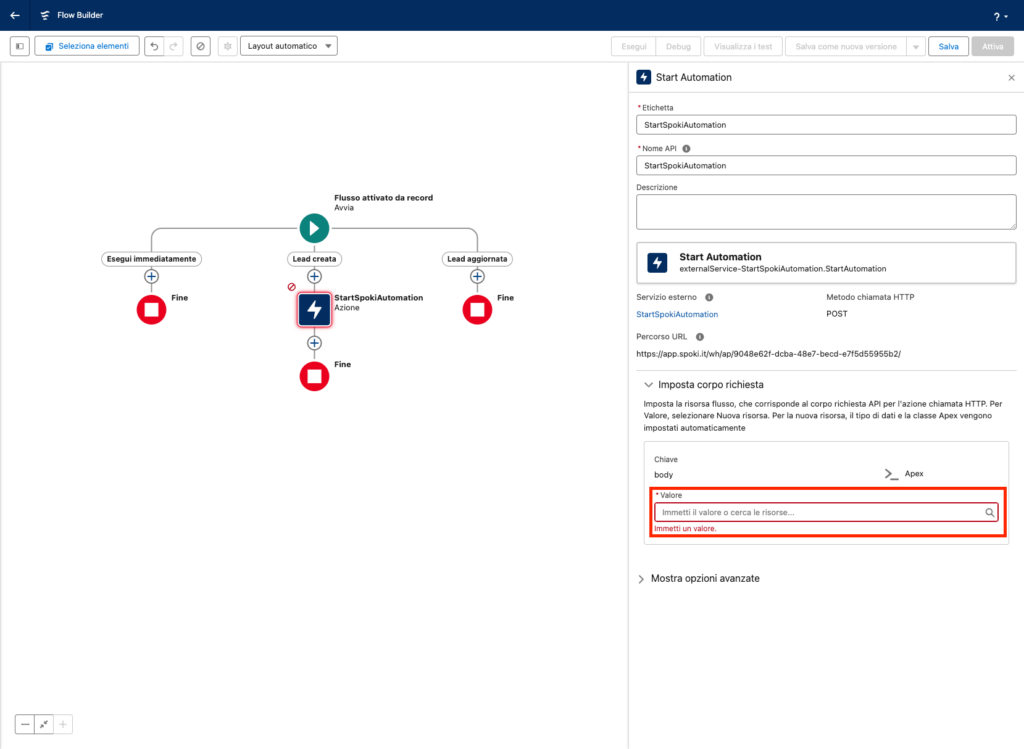
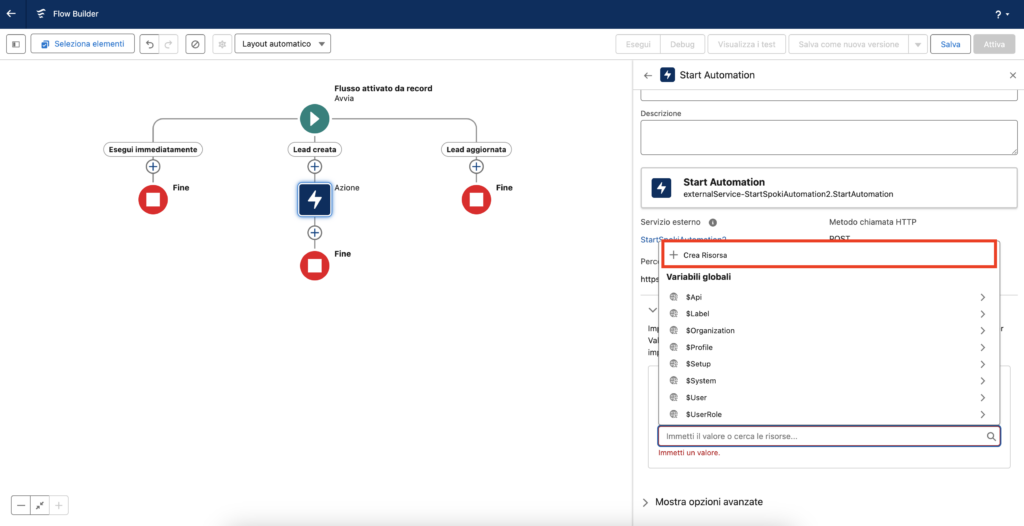
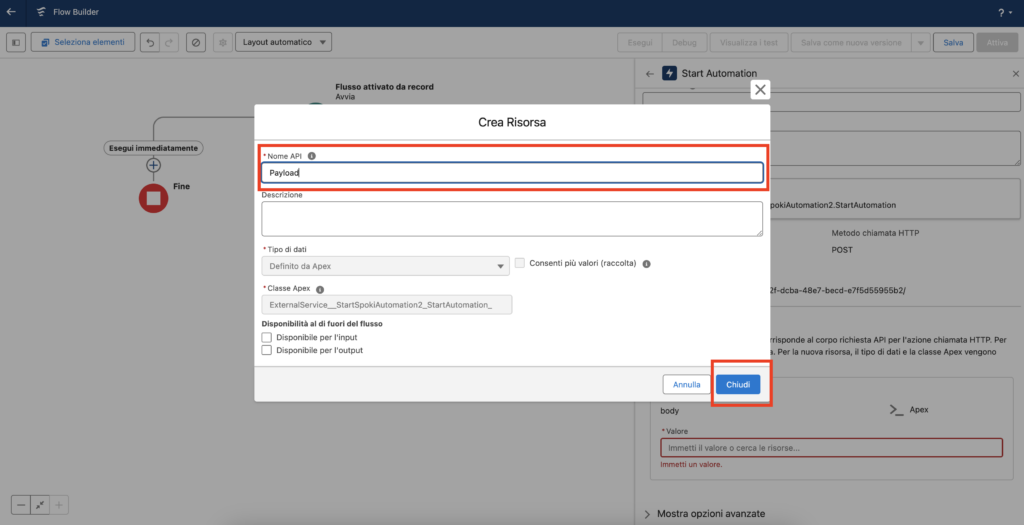
Enter a value in the API Name field. This will be the name of the variable to pass within the payload of the request. Then, click Close
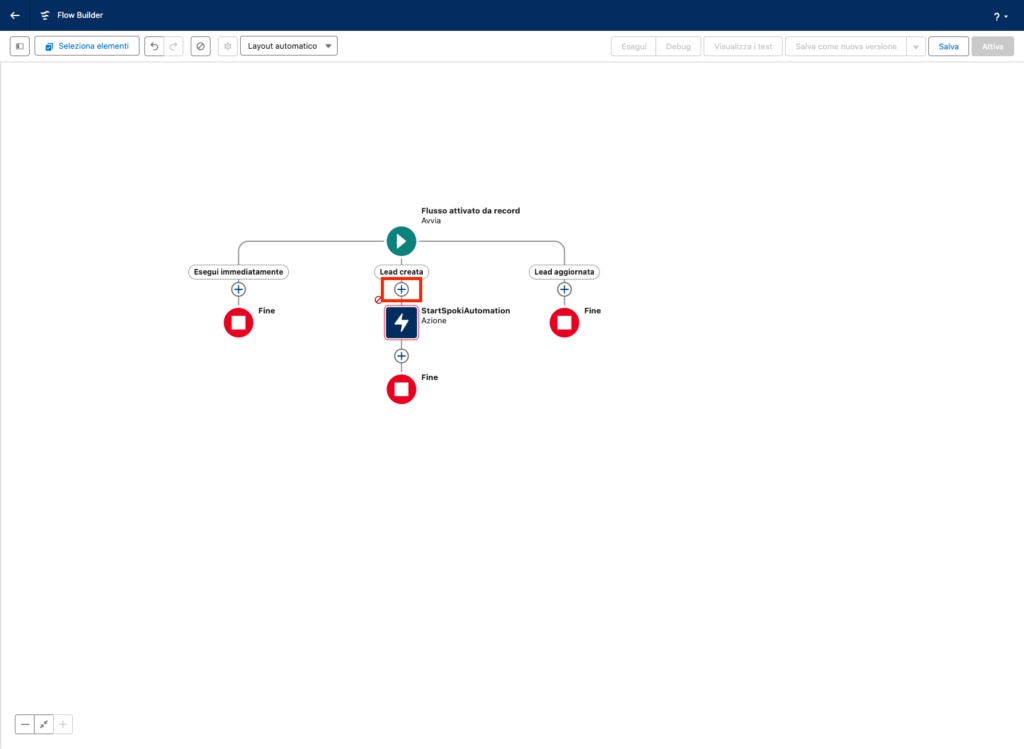
Click on the + before the Action step and select the Assignment element
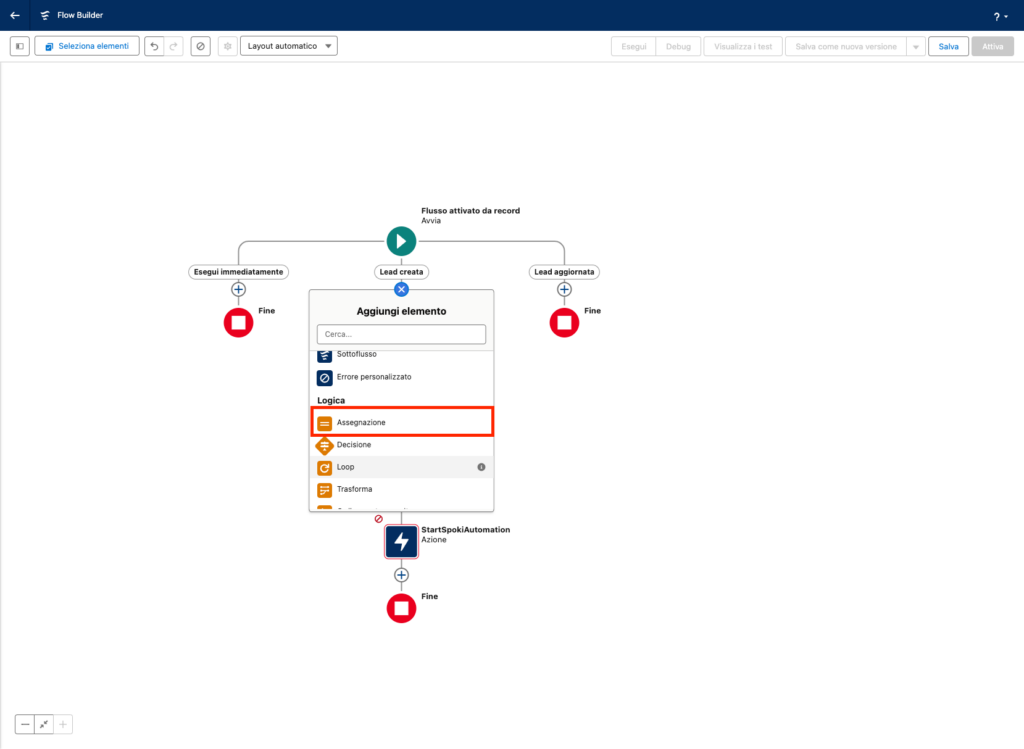
Enter a value in the Label field and one in the API Name field.
Next, click on Search Variables and click the arrow next to the name of the variable you created earlier. Inside, you will find all the fields of the payload to pass to the Spoki automation. Click on phone
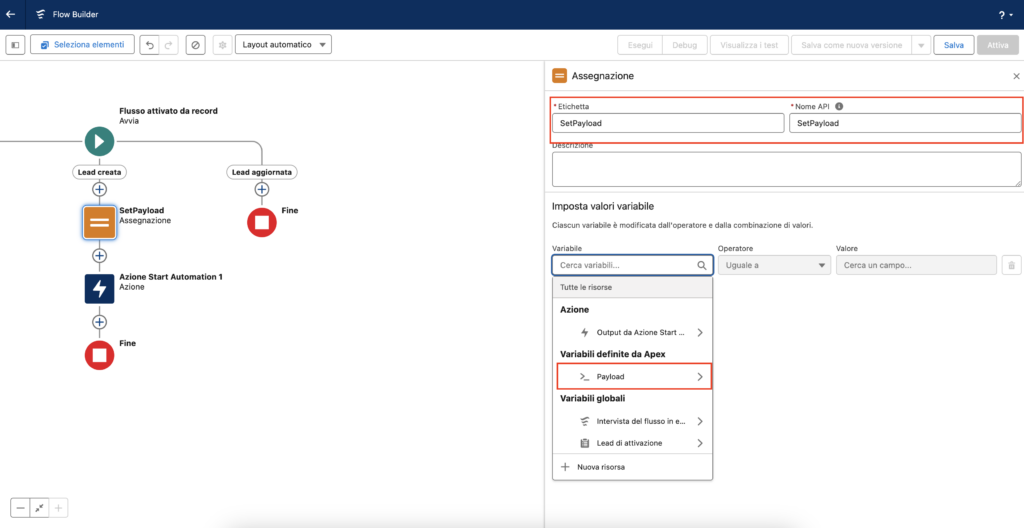
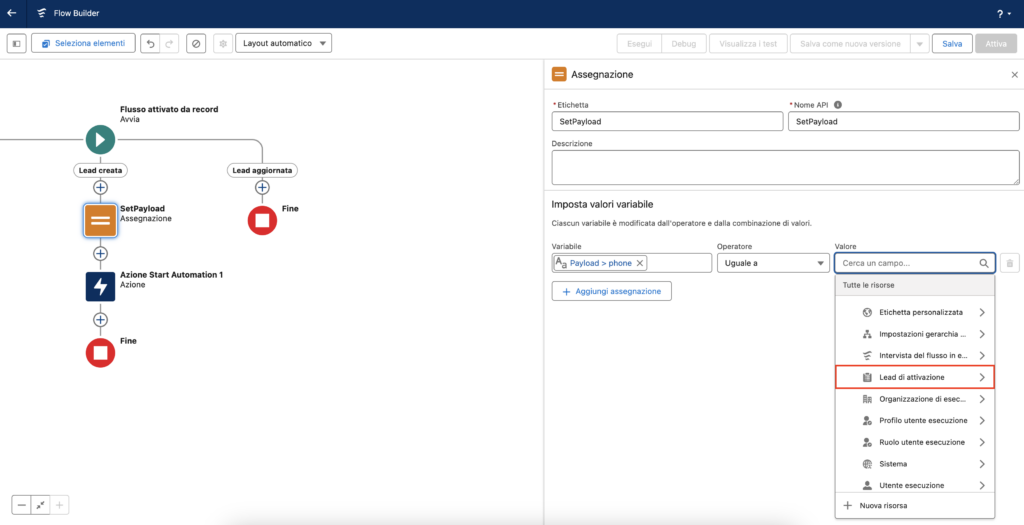
Click on Value, and from the list, click the arrow next to Triggering Lead (in this case, it’s Lead, but it will change depending on the object that triggers the automation). Inside, you will find all the fields of the lead. Click on Phone
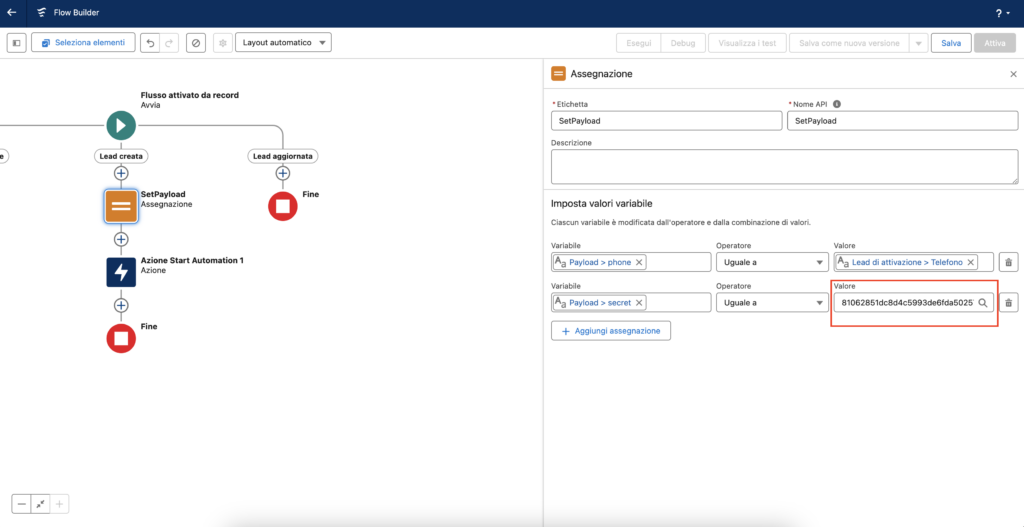
Repeat the process for the Secret field in the payload. In the Value field, enter the secret provided by Spoki during the automation creation phase.
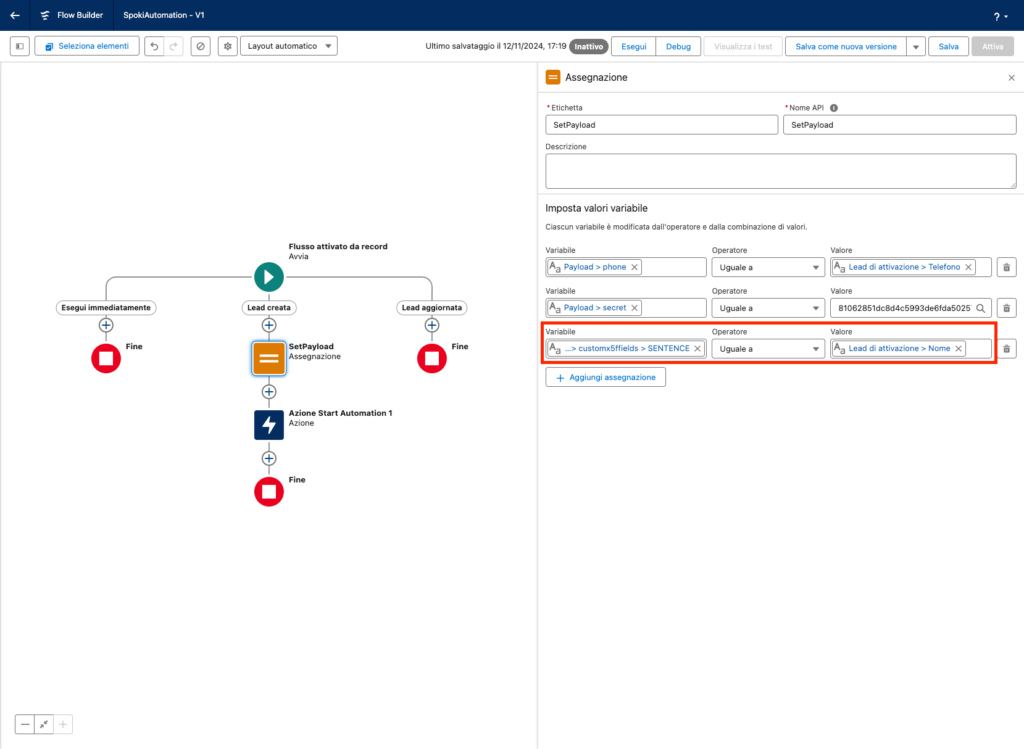
Repeat the process for the custom_fields in the payload as shown in the figure. In our case, the custom field is called SENTENCE, and it has been populated with the Lead Name
Copy the Assignment step to insert it into the Lead Updated path. To do this, click on the step and then click Copy Element
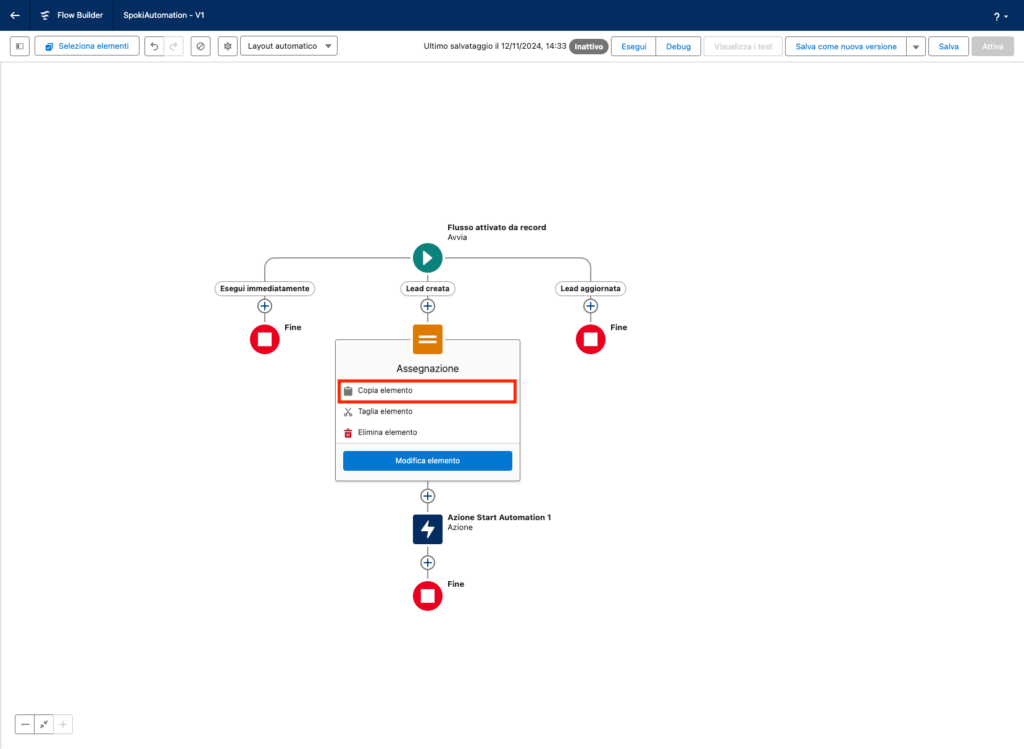
Click on the + in the Lead Updated path and then click on Paste 1 Element
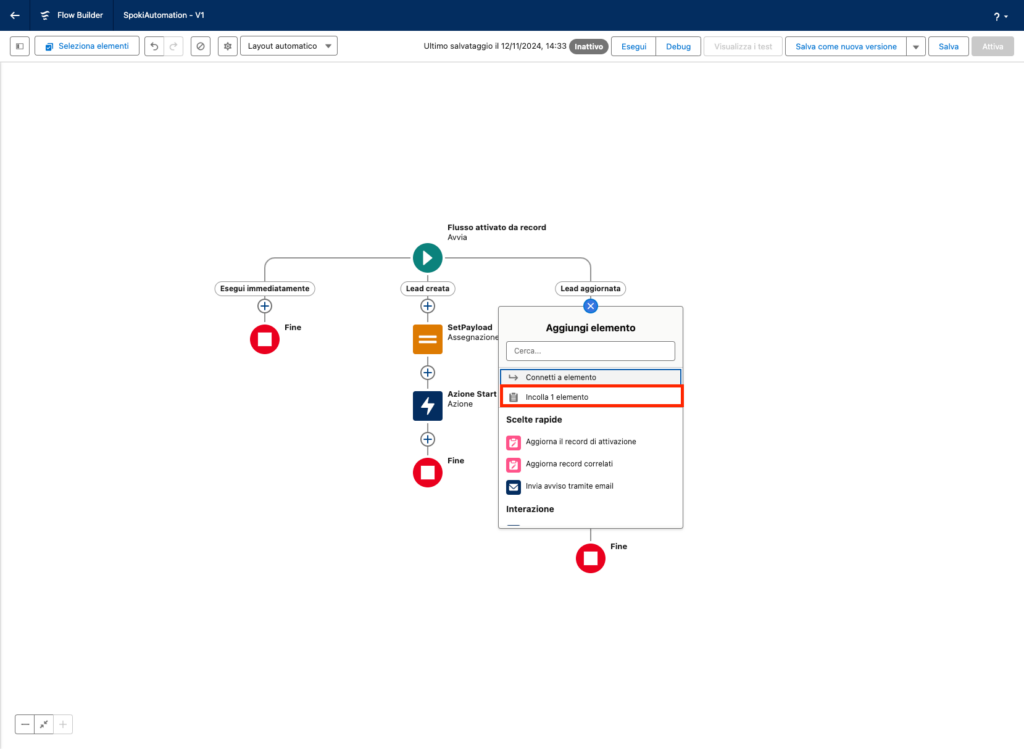
Repeat the process for the Action step as shown in the images below.
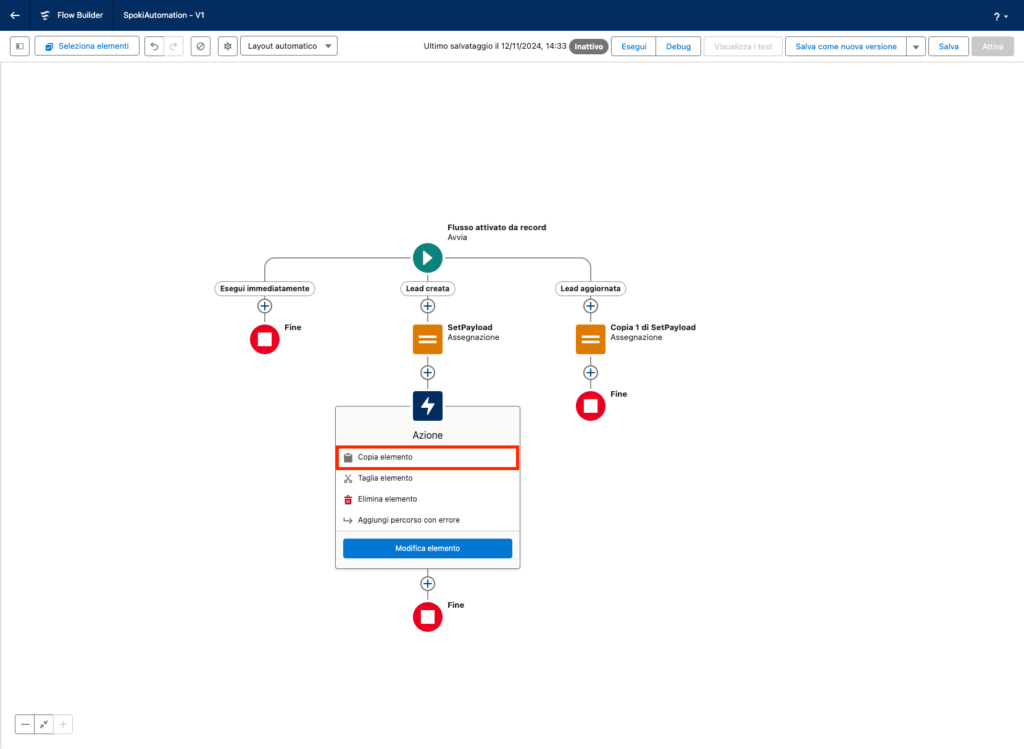
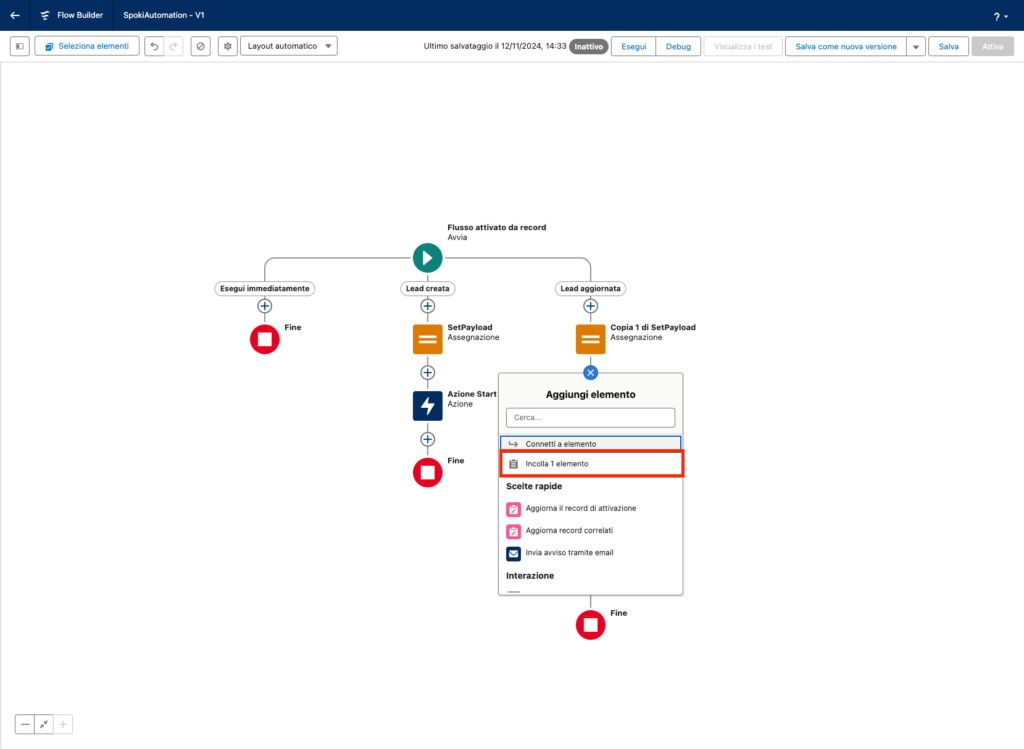
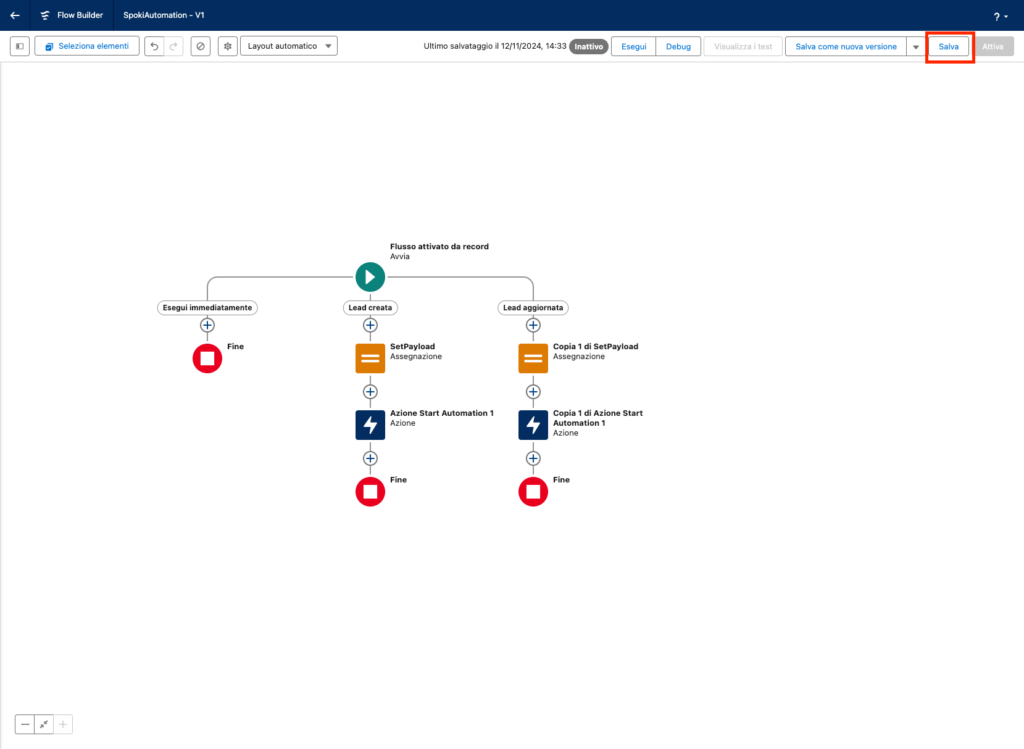
At the end, you should have a flow structure like the following. In both paths, you will have the Assignment step and the Action step.

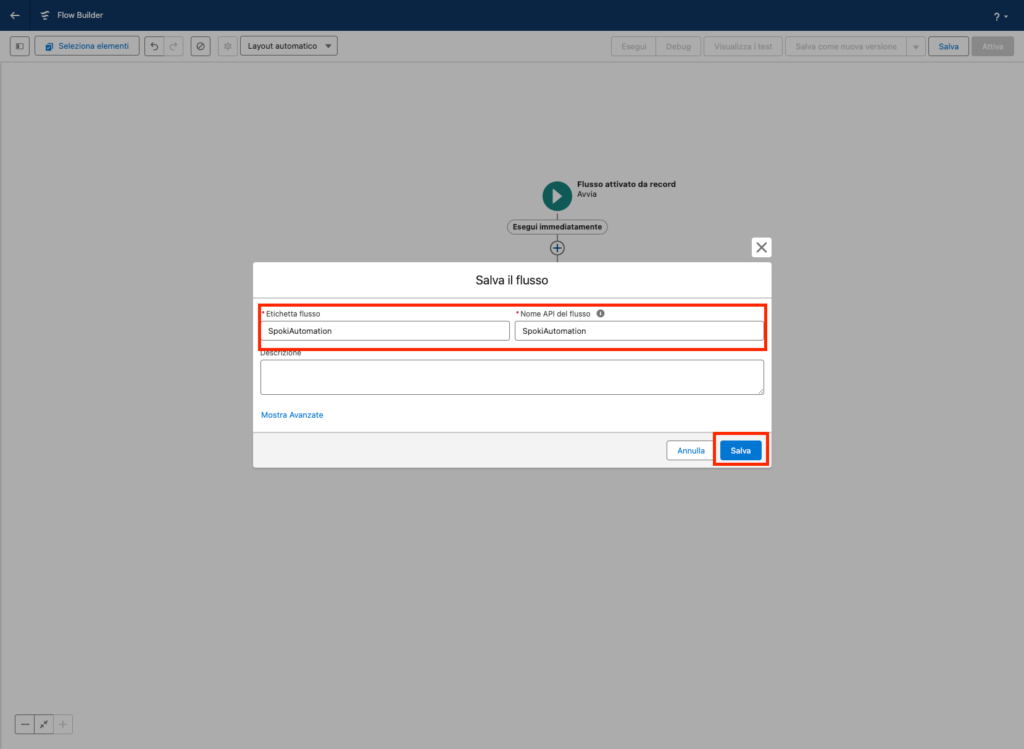
Click Save at the top right to save the flow, then enter a value for Flow Label and Flow API Name. Finally, click Save again.
2.2.2 Salesforce Flow test #

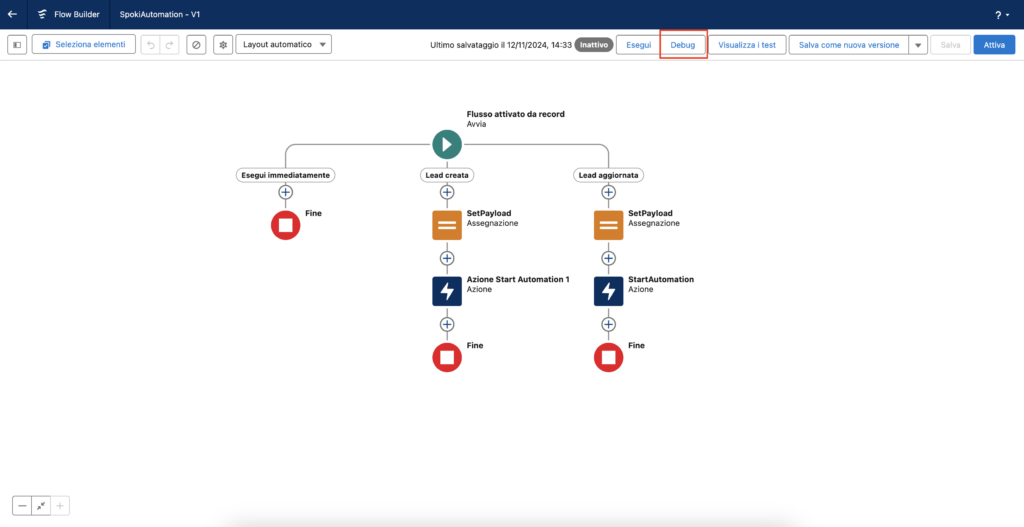
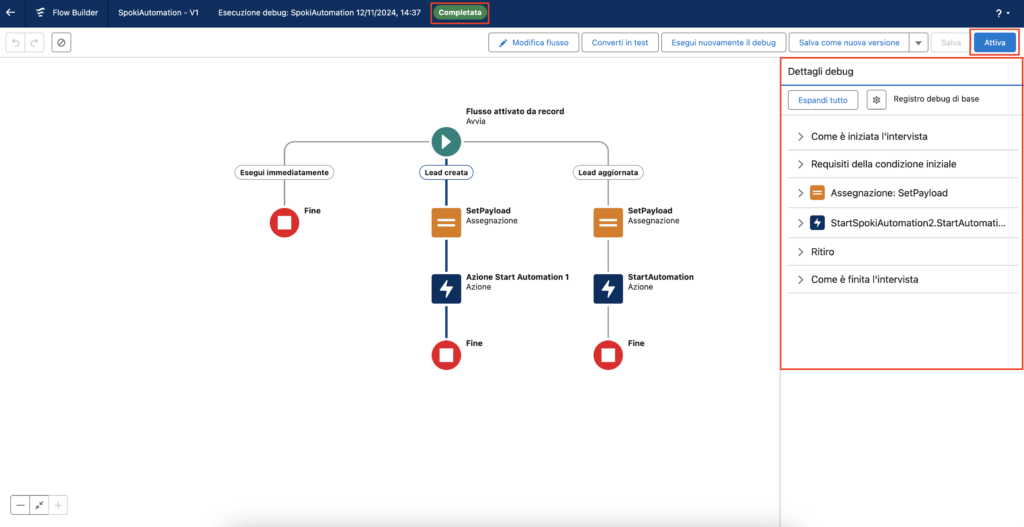
To test the flow click on the Debug button on top.
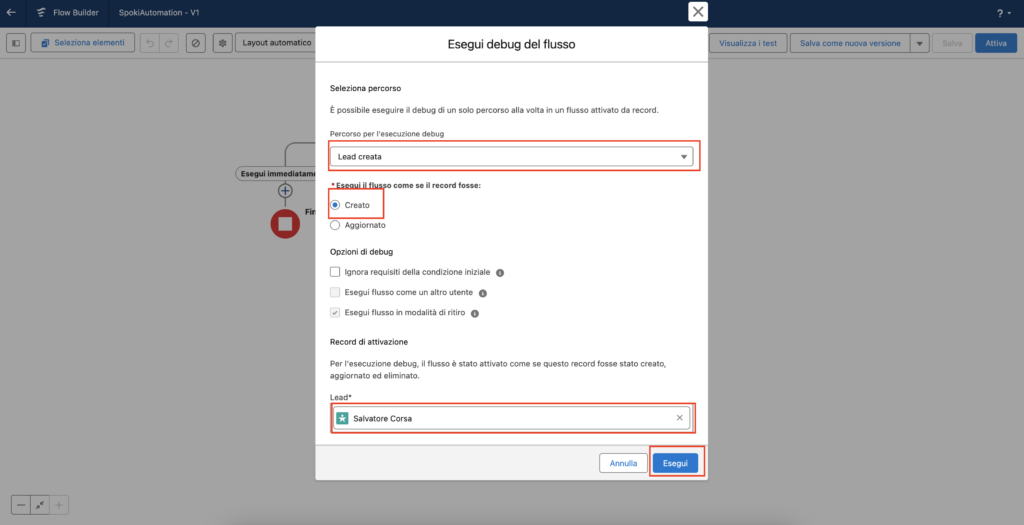
In the debug path, select one of the two paths created at the beginning. Select the Created or Updated checkbox depending on the chosen path, and finally select a test Lead from the list at the bottom. Click Run to start debugging the flow.
On the right, you can see the execution details, while at the top, the label Completed confirms that the flow was executed without any errors. To activate the flow, click Activate in the top right corner.
What are your Feelings
Share This Article :
  • Facebook
  • X
  • LinkedIn
  • Pinterest
Still stuck? How can we help?

How can we help?

Updated on November 15, 2024
Magnews Flow

Powered by BetterDocs

Table of Contents
  • Integration Guide
  • 1. Spoki Automation
    • 1.1 Create a New Automation
    • 1.2 Add the start trigger
    • 1.3 Add a step to the automation.
  • 2. Salesforce Flow
    • 2.1 Webhook configuration in Salesforce.
    • 2.1.1 Creation of Named Credentials
    • 2.1.2 Creating Permissions to Use Named Credentials
    • 2.2 Salesforce Flow
    • 2.2.1 Creating a Salesforce Flow
    • 2.2.2 Salesforce Flow test
DEVELOP YOUR BUSINESS WITH SPOKI AND WHATSAPP
Try now for free

Contacts

  • info@spoki.it
  • +39 351 5495135
  • Informativa Privacy

Menu

  • Home
  • Prices
  • Functionality
  • Integrations
  • Artificial Intelligence
  • About us

Solutions

  • Marketing
  • Sales
  • Customer Care
  • Developers

Support

  • API Documentation
  • Blog
  • Case Study
  • Learning Center
  • Manual

Spoki.it © All rights reserved NextAI Srl P.IVA IT02717930743 Viale Francia snc, 72019 San Vito Dei Normanni (BR) Italy

Soluzioni

  • Marketing
  • Vendita
  • Assistenza Clienti
  • Developers
  • Italiano (Italian)
  • English